
AI Search Optimization: How to Get Your Website Mentioned by AI
Introduction
Search is changing.
For years, getting traffic from search meant competing for positions on Google and other traditional search engines. Today, people are increasingly asking AI-powered search systems to research topics, compare products, explain complicated questions, and recommend sources.
Instead of showing only a list of blue links, AI-powered search can generate an answer and use information from multiple websites to build that response.
That creates a new question for website owners:
How can you make your website visible when people search through AI?
This is where AI Search Optimization comes in.
AI Search Optimization is the process of improving a website’s content, structure, accessibility, and authority so that AI-powered search systems can more easily discover, understand, trust, and potentially cite its information.
It does not replace traditional SEO. Instead, it builds on many of the same fundamentals.
Google’s current guidance says that the same foundational SEO practices remain important for appearing in its AI-powered search features.
What Is AI Search Optimization?
AI Search Optimization is the practice of preparing your website so AI-powered search experiences can understand and use your content.
You may also see related terms such as:
- AI SEO
- Generative Engine Optimization (GEO)
- AI visibility
- Answer Engine Optimization (AEO)
- Generative Search Optimization
These terms overlap, but the basic goal is similar:
Make your content easy for search systems and AI systems to discover, understand, verify, and reference.
Traditional SEO focuses heavily on questions such as:
“How can my page rank for this keyword?”
AI search introduces another question:
“How can my website become a useful source for an AI-generated answer?”
Why AI Search Optimization Matters
AI search is becoming an increasingly important part of the search ecosystem.
Google is expanding AI-powered features in Search, while Microsoft has introduced AI Performance reporting in Bing Webmaster Tools that shows when website content is cited in AI-generated answers across Microsoft Copilot, AI-generated Bing summaries, and selected partner integrations.
OpenAI also says that public websites can appear in ChatGPT search and recommends allowing OAI-SearchBot to crawl relevant content if publishers want their pages to be discoverable and cited.
The industry is also developing new ways to measure AI visibility. Ahrefs reported that searches for “AI search tracking” increased 184% and “AI rank tracking” increased 175% in its 2026 data.
This doesn’t mean every website needs a completely new SEO strategy.
It means website owners should start thinking beyond traditional rankings.
How Does AI Search Work?
AI search systems can combine information from different sources to produce an answer.
A simplified process looks like this:
User question → AI understands intent → Relevant information is retrieved → Sources are evaluated → Answer is generated → Sources may be cited
For example, someone might ask:
“What are the best ways to improve website speed?”
Instead of opening ten results, an AI search system may retrieve information from several relevant pages and generate a summarized response.
If your page contains clear, useful, trustworthy and well-structured information, it has a better chance of being understood and considered as a source.
However, there is no guaranteed method that makes an AI system cite a particular website. OpenAI explicitly notes that search placement is not guaranteed.
10 AI Search Optimization Techniques
1. Create Content That Actually Answers Questions
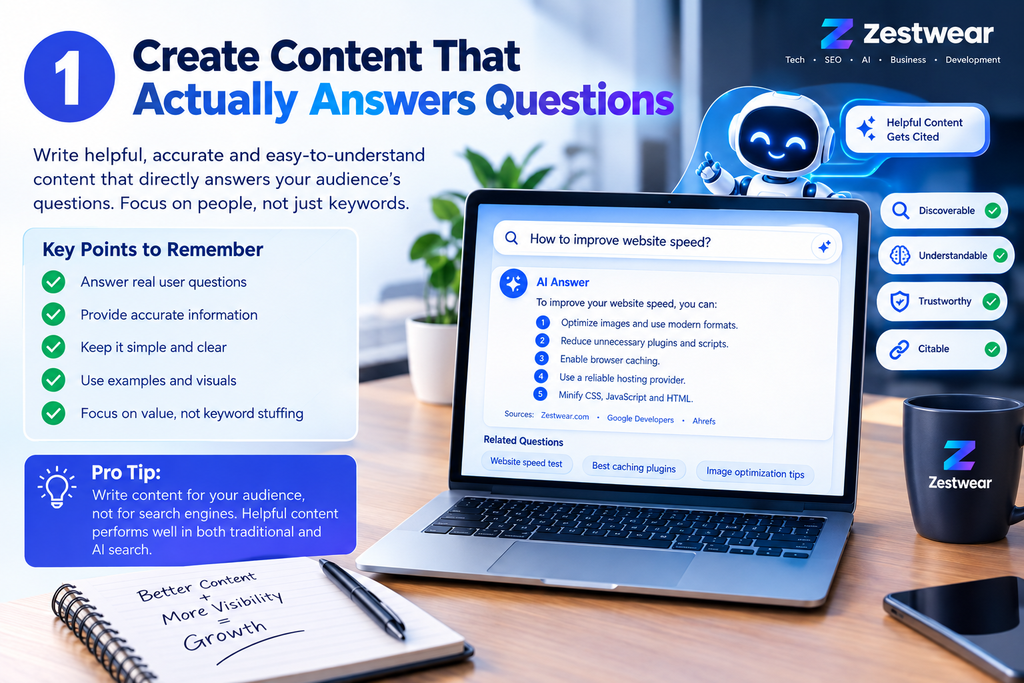
The first rule is simple:
Create useful content for people, not content designed only to manipulate search engines.
Instead of writing:
“SEO is important because SEO helps websites with SEO…”
Answer the actual question.
For example:
Question:
“How do I improve my website’s SEO?”
A useful article could explain:
- Technical SEO
- Search intent
- Content quality
- Internal linking
- Page experience
- Structured data
- Authority and references
- Performance measurement
Google’s guidance emphasizes creating helpful, reliable, people-first content rather than content primarily created to manipulate search rankings.
2. Understand Search Intent

AI systems don’t only need keywords.
They need to understand what the user is actually asking.
Compare:
Keyword-focused:
website speed
Intent-focused:
“How can I make my WordPress website load faster?”
The second query gives much more context.
When creating content, identify whether the reader wants to:
- Learn something
- Compare options
- Solve a problem
- Buy something
- Follow a tutorial
- Research a topic
Then structure your article around that intent.
3. Write Clear and Direct Answers
AI-generated answers often need concise pieces of information that can be understood without excessive interpretation.
Instead of hiding your answer inside five paragraphs, answer important questions directly.
Example
What is AI Search Optimization?
AI Search Optimization is the process of improving website content and technical accessibility so AI-powered search systems can discover, understand, and potentially reference the information.
Then explain the subject in greater detail below it.
This structure benefits human readers too.
4. Use Clear Headings and Structure
A well-organized article is easier to navigate.
Use:
- One clear H1
- Relevant H2 sections
- H3 subsections
- Short paragraphs
- Bullet points
- Tables when useful
- Examples
- Definitions
For example:
H1: AI Search Optimization
H2: What Is AI Search Optimization?
H2: Why AI Search Matters
H2: How AI Search Works
H2: AI Search Optimization Techniques
H3: Create Helpful Content
H3: Improve Technical SEO
H3: Build Topical Authority
This makes the article easier for both readers and search systems to understand.
5. Strengthen Your Traditional SEO
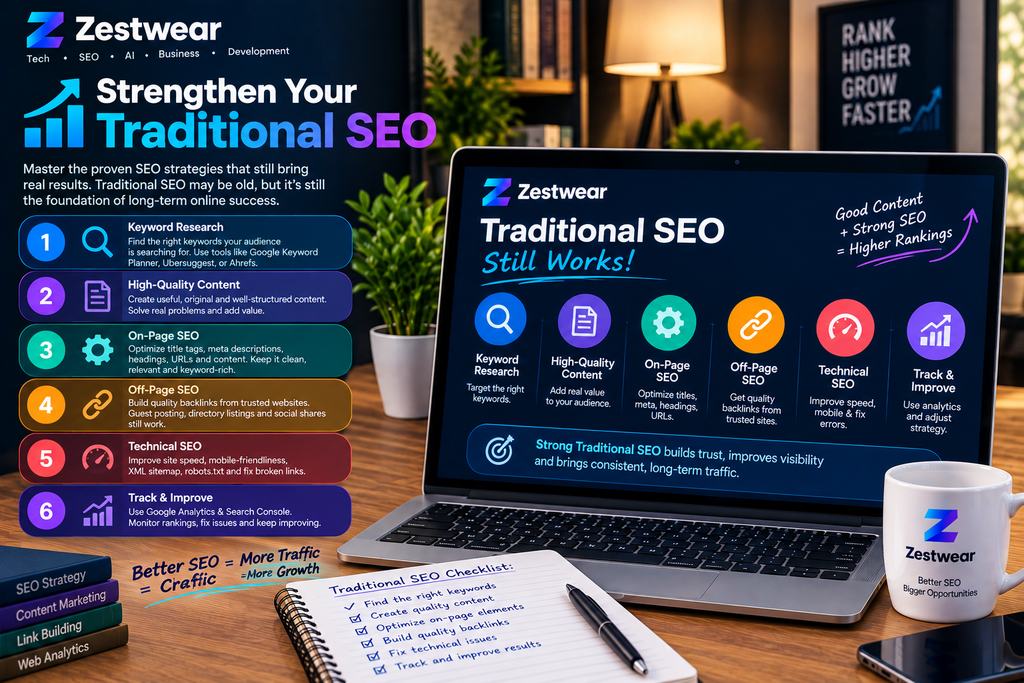
One of the biggest misconceptions about AI search is that traditional SEO no longer matters.
It does.
Google’s current documentation specifically says that its existing SEO fundamentals continue to apply to AI features in Search.
That means you should still pay attention to:
- Crawlability
- Indexing
- Page titles
- Internal links
- Descriptive URLs
- Mobile usability
- Page experience
- Structured data where appropriate
- Helpful content
- Relevant backlinks and mentions
AI search is not a shortcut around SEO.
6. Make Your Website Easy to Crawl
An AI system cannot easily use content that it cannot access.
Check your:
robots.txt
Meta robots directives
Canonical URLs
XML sitemap
Server accessibility
Firewall/CDN rules
For ChatGPT search specifically, OpenAI recommends allowing OAI-SearchBot to crawl website content that you want discoverable.
A technical SEO audit should therefore include AI crawler accessibility alongside traditional search-engine crawlers.
7. Add Original Information
This can be one of the most valuable ways to differentiate your content.
Instead of rewriting information that already exists on hundreds of websites, add something new.
For example:
- Original research
- Experiments
- Data
- Case studies
- Expert interviews
- Screenshots
- First-hand testing
- Unique comparisons
- Real examples
Google’s 2026 guidance for generative AI features specifically highlights the importance of non-commodity content—content that provides something beyond information that can easily be found everywhere else.
Think:
Don’t just summarize the internet. Add something to it.
8. Build Topical Authority
Publishing one article about SEO isn’t enough to establish deep topical coverage.
Imagine a website covering:
SEO
Then build related content around:
- Technical SEO
- Keyword research
- Search intent
- Internal linking
- Schema markup
- Core Web Vitals
- AI search
- AI visibility
- Content optimization
- Link building
- Search Console
These pages can connect through internal links.
This creates a stronger topical structure and helps readers—and search systems—understand what your website covers.
9. Use Structured Data Correctly
Structured data helps search engines understand specific information on a page.
Google explains that structured data provides explicit information about page content and can make pages eligible for certain search features.
Depending on the page, relevant structured data can include things such as:
- Article
- Breadcrumb
- Product
- Organization
- Local Business
- Software Application
But don’t add schema simply because you think it will automatically make an AI system cite your website.
Use it when it accurately represents the page.
10. Measure AI Visibility
Traditional SEO measurement often focuses on:
- Rankings
- Impressions
- Clicks
- Organic traffic
AI search introduces additional measurements:
- Brand mentions
- Citations
- AI-generated answer appearances
- AI referral traffic
- Cited URLs
- Conversion activity
Bing’s AI Performance tool now provides visibility into how URLs are referenced in AI-generated answers.
And the AI-search industry is increasingly developing tools specifically for tracking mentions, citations and AI-driven traffic.
The important point is:
Don’t measure AI visibility only by whether your brand appears once. Measure whether that visibility produces useful traffic and actions.
AI Search Optimization vs Traditional SEO
| Traditional SEO | AI Search Optimization |
| Focuses heavily on search rankings | Focuses on visibility within AI-generated answers |
| Keywords are important | Topics, entities and user intent are important |
| SERP positions are commonly tracked | Mentions and citations can be tracked |
| Links lead directly to pages | AI may summarize information before showing sources |
| Search snippets matter | Clear, extractable information matters |
| Technical SEO matters | Technical accessibility still matters |
These approaches aren’t competitors.
AI Search Optimization should generally be treated as an extension of modern SEO rather than a replacement for it.
Common AI SEO Myths
Myth 1: “You need a secret AI SEO trick.”
There is no guaranteed trick that makes an AI system cite your website.
Google’s documentation emphasizes established SEO fundamentals for its AI search features.
Myth 2: “Just add AI keywords to your article.”
Simply mentioning phrases such as “AI search” or “GEO” doesn’t automatically make content useful.
The content needs to satisfy the user’s question.
Myth 3: “AI search means Google SEO is dead.”
Current Google guidance says the opposite: existing SEO best practices remain relevant to AI features.
Myth 4: “Add an llms.txt file and you’ll rank in AI search.”
Google’s June 2026 documentation clarification says llms.txt isn’t required for Google Search and doesn’t positively or negatively affect Google Search visibility or rankings.
AI Search Optimization Checklist
Before publishing an article, ask:
Content
- Does the article answer a real question?
- Is the information accurate?
- Does it provide original value?
- Are important answers clearly explained?
SEO
- Is the primary search intent clear?
- Is the title descriptive?
- Are headings organized?
- Are internal links relevant?
- Is the URL clean?
Technical
- Can search engines crawl the page?
- Is the page indexable?
- Is the website mobile-friendly?
- Does the page load properly?
- Is structured data accurate where appropriate?
AI Visibility
- Can AI crawlers access the content?
- Does the page contain clear, useful information?
- Does it have original insights or data?
- Are important claims supported by credible sources?
- Are you monitoring mentions, citations or AI-driven traffic?
The Future of Search Is Not Just About Rankings
Search is moving from a world where people primarily browse results toward experiences where AI can understand questions, retrieve information and synthesize answers.
That doesn’t mean websites are becoming irrelevant.
It means the role of a website can change.
A page may be discovered through traditional search, referenced inside an AI-generated answer, cited as a source, or visited after a user wants to investigate the information further.
Microsoft’s Bing team describes this shift as search evolving from simple retrieval toward systems that interpret intent and generate synthesized answers.
For website owners, the practical strategy is straightforward:
Create genuinely useful information. Make it technically accessible. Structure it clearly. Build authority around your topic. Add original value. Then measure where your visibility comes from.
That’s the foundation of AI Search Optimization.
Final Takeaway
AI Search Optimization isn’t about finding a secret formula to force ChatGPT, Google, Gemini, or another AI system to mention your website.
It’s about making your website worth discovering, understanding and referencing.
The websites that focus on helpful information, strong technical foundations, clear structure, trustworthy sources and original insights will be better positioned for the changing search environment.
And the biggest opportunity isn’t simply:
“How do I rank #1?”
It’s increasingly:
“How do I become one of the sources AI systems trust when answering my audience’s questions?”
That is the question modern SEO needs to start answering.