
Master Headless Architecture vs. Monolithic CMS: Unleash Ultimate Site Speed and Workflow Growth in 2026
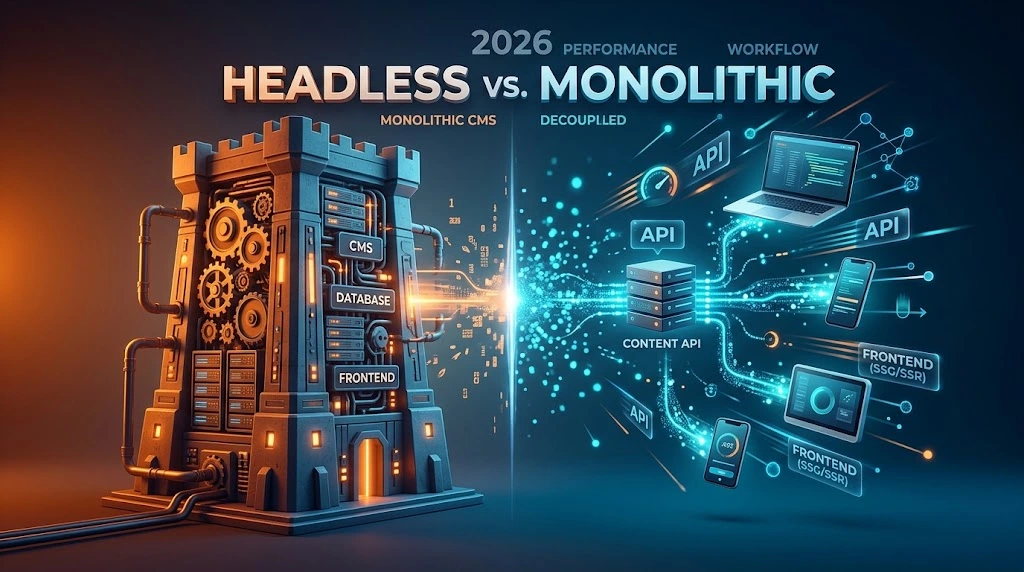
When a website starts feeling sluggish or the tech stack begins to choke under heavy traffic, the conversation almost always turns to architecture.
For years, the standard approach was simple: spin up a monolithic CMS (like traditional WordPress, Drupal, or Magento), pick a pre-built theme, plug in a database, and start publishing. It worked because everything was self-contained.
However, as performance requirements grow stricter—driven by search engine expectations around Core Web Vitals and user demands for near-instant load times—the architectural monolithic model often runs into performance bottlenecks.
Enter Headless CMS architecture. By decoupling the backend content management system from the frontend presentation layer, headless setups unlock complete frontend freedom and superior site performance. But it comes with real operational complexity.
Let’s break down the technical realities, performance trade-offs, and workflow shifts between Monolithic and Headless architectures so you can evaluate what actually makes sense for your stack.
1. Mastering Technical Fundamentals: How Monolithic vs. Headless Architectures Process Data
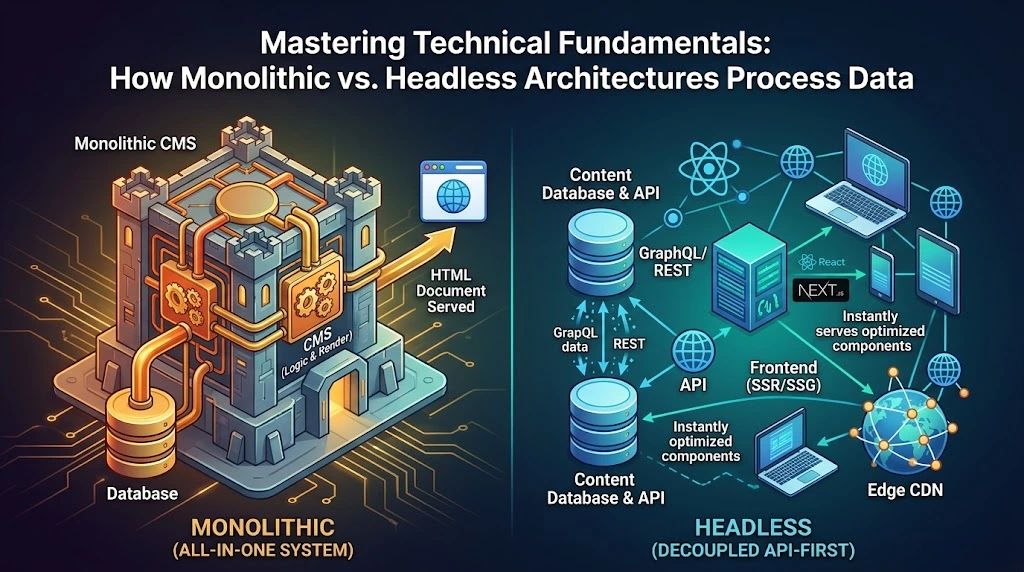
To evaluate performance differences, we must analyze how data flows from the underlying database to the client browser across both models.
Monolithic CMS Model:
[ Database ] <—> [ CMS Monolith (Logic + Rendering Engine) ] —> [ HTML Document Served ]
Headless CMS Model:
[ Headless CMS / DB ] —> [ GraphQL / REST API ] —> [ Frontend SSG/SSR (Next.js/Nuxt) ] —> [ Edge CDN ]
Evaluating Monolithic CMS Limitations (Coupled Architecture)
In a traditional monolith, the backend database, administrative UI, business logic, and frontend template engine (e.g., PHP rendering HTML) reside in a single environment.
- How it renders: When a user requests a page, the server queries the database, executes the application code, processes shortcodes or plugin hooks, stitches together the final HTML document, and streams it back to the client.
- The bottleneck: Every incoming request risks triggering heavy PHP/database queries unless aggressive server-side and object caching layers (like Redis or Varnish) are configured properly.
Unlocking Headless CMS Capabilities (Decoupled Architecture)
A headless CMS strips away the frontend presentation layer entirely. It acts purely as a Content Management API. Content creators enter data into the CMS backend, which exposes that content via REST or GraphQL endpoints. A completely separate frontend application (built with Next.js, Nuxt, Astro, or React) consumes the API and builds the UI.
- How it renders: Frontend pages are typically statically pre-generated at build time (Static Site Generation – SSG) or pre-rendered at the server edge on demand (Server-Side Rendering – SSR / Incremental Static Regeneration – ISR).
- The structural shift: The database is completely hidden behind an API layer, isolating public traffic entirely from your CMS administration backend.
2. Analyzing Performance Trade-Offs: Speed, Metrics, and Runtime Overhead
When comparing speed, load metrics, and runtime overhead, both architectures have distinct strengths and vulnerabilities.
Optimizing Server Response Time and TTFB
- Monolithic: Delivering low TTFB requires heavy caching infrastructure. Without static HTML caching, every dynamic request forces the server to process backend logic and wait for SQL queries. Unoptimized plugins or heavy database overhead directly penalize TTFB.
- Headless: Because modern headless frontends are frequently deployed onto Global Edge Networks (like Vercel, Netlify, or Cloudflare Workers), pre-rendered static HTML is served directly from the POP (Point of Presence) closest to the user. This yields near-instant TTFB globally without complex origin server tuning.
Boosting Core Web Vitals (LCP and INP)
- Largest Contentful Paint (LCP): Headless setups utilizing modern frontend frameworks excel here because assets can be precisely tuned—eliminating render-blocking CSS and unnecessary JavaScript overhead inherent in legacy CMS themes. To learn more about auditing your site speed, fixing database bloat, and optimizing core metrics, check out Zestwear.pk
- Interaction to Next Paint (INP): Headless sites can sometimes suffer if over-engineered with massive client-side JavaScript bundles. If a Headless React/Next.js site relies heavily on client-side hydration, main-thread blocking can degrade INP score. Conversely, a clean Monolithic site with light, native JS can achieve pristine INP with minimal effort.
Eliminating Render-Blocking JavaScript Overhead
To keep INP low in a headless setup, developers must strictly manage hydration, implement lazy loading for non-critical JS components, and utilize modern rendering approaches detailed in the official React Server Components documentation.
Mitigating Security Risks and Database Bottlenecks
- Monolithic: High traffic spikes directly impact the database. If a database isn’t routinely pruned or indexed, page execution slows down across the entire site. Furthermore, exposing the CMS admin directly to the web increases the attack surface for automated bots and brute-force attempts.
- Headless: High public traffic never touches the CMS database; visitors only interact with pre-rendered static files or API cache layers on a CDN. This eliminates database overhead as a primary cause for site slowdowns during traffic spikes and drastically hardens security.
3. Streamlining Workflows: Operational Realities for Web Teams
Architecture isn’t just about load times; it reshapes how your engineering and editorial teams operate daily.
| Operational Dimension | Monolithic CMS | Headless Architecture |
| Developer Skillset | Requires expertise in CMS-specific ecosystems (PHP, custom hooks, CMS theme API). | Requires modern JavaScript/TypeScript engineering (React, Next.js, GraphQL, API integration). |
| Content Editing Experience | WYSIWYG / Live Preview: Instant visual feedback out of the box with native page builders. | Structured Data: Excellent for structured content, but real-time preview requires custom preview environment setups. |
| Development Velocity | Fast for launching standard marketing sites using pre-existing themes and plugins. | Higher initial setup time, but offers complete design flexibility and component reusability. |
| Maintenance & Upgrades | Requires continuous patching of core CMS, database optimization, and plugin compatibility checks. | Backend and frontend are isolated; updating frontend frameworks won’t break your content database. |
Navigating the Developer Workflow Shift
In a monolith, developers spend a significant amount of time fighting platform constraints, optimizing database queries, and managing theme templates.
In a headless ecosystem, frontend developers enjoy total freedom over build tools, styling libraries, and web performance budgets. However, engineering overhead shifts toward managing deployment pipelines, API rate limits, environment variables, and build automation (CI/CD).
Scaling Editorial Team Productivity
Non-technical team members often face a learning curve when transitioning to a Headless CMS. Because content is decoupled from layout, authors manage data fields rather than visually designing pages on a visual canvas. Setting up robust preview environments so marketers can see drafts before publication requires deliberate upfront engineering.
4. Comparing Architectures: Monolithic vs. Headless Matrix
+————————+————————————+————————————+
| Feature / Metric | Monolithic CMS | Headless Architecture |
+————————+————————————+————————————+
| Global Edge Delivery | Requires CDN configuration | Native via SSG/Edge Deployment |
| Technical Complexity | Low to Moderate | Moderate to High |
| Frontend Flexibility | Tied to CMS Templating Engine | 100% Unconstrained |
| Initial Cost & Time | Lower initial investment | Higher upfront engineering cost |
| Security Profile | Broader attack surface | Highly isolated & secure |
| Database Bottlenecks | Can directly degrade page speed | Decoupled from public user traffic |
+————————+————————————+————————————+
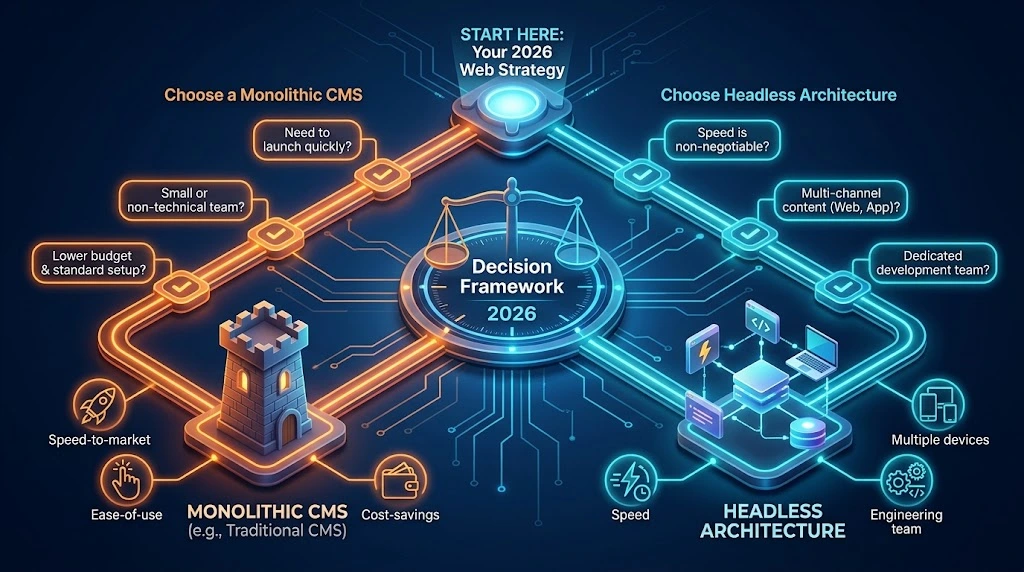
5. Decision Framework: Choosing the Right Strategy for 2026
When to Choose a Monolithic CMS
- Speed to market is paramount: You need a fully functional website launched quickly with minimal custom engineering.
- Small or non-technical team: Your primary team consists of content creators who rely heavily on visual page builders and out-of-the-box plugin extensions.
- Budget constraints: You prefer lower upfront setup costs and straightforward, single-server or managed hosting setups.
When to Choose Headless Architecture
- Performance is a non-negotiable KPI: You are building high-traffic platforms, enterprise e-commerce stores, or media sites where every millisecond impacts conversions and SEO ranking.
- Multi-channel content delivery: You need to publish content simultaneously to a web application, mobile app, IoT devices, or multiple frontends from a single source of truth.
- Dedicated development resources: You have access to frontend engineers capable of building and maintaining custom frontend applications and deployment pipelines.
Final Thoughts
Neither architecture is inherently “better”—they solve different problems at different scales.
Monolithic CMS platforms remain powerhouse engines for rapid deployment and traditional web publishing when paired with aggressive caching and disciplined database maintenance. On the other hand, Headless architecture unlocks unmatched frontend speed, architectural flexibility, and security for teams ready to invest in modern web engineering.
Evaluating your team’s technical capacity, budget, and performance targets upfront will dictate which path provides the highest return on effort.