
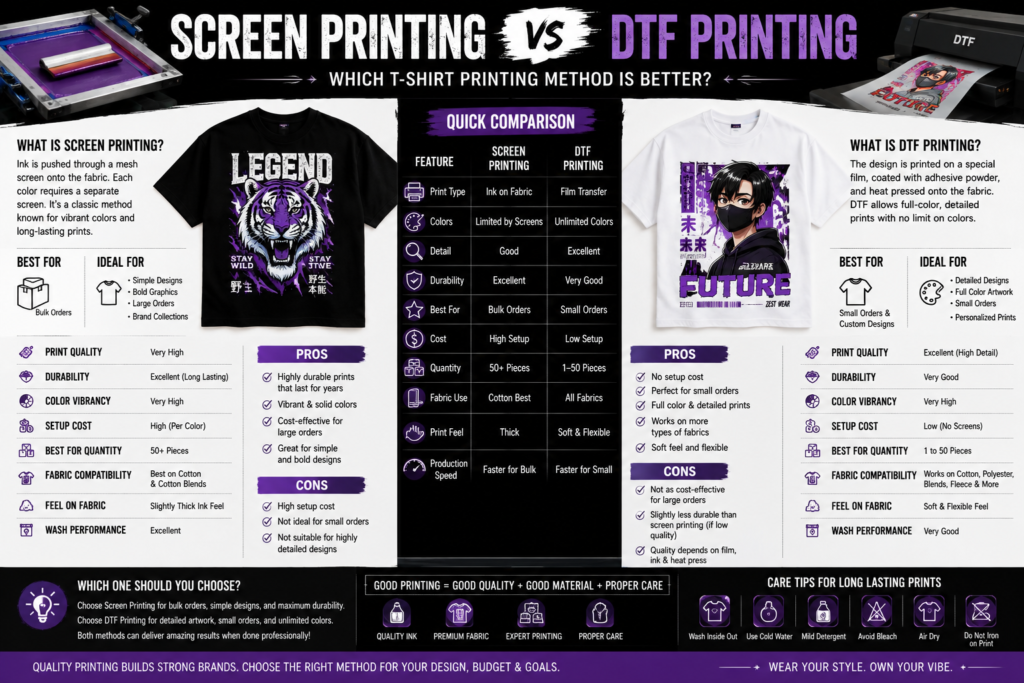
Screen Printing vs DTF Printing: Which Printing Method Should You Choose?
The custom apparel industry has grown rapidly over the last few years, and two printing methods dominate the market today: Screen Printing and Direct-to-Film (DTF) Printing.
Whether you’re launching a streetwear brand, ordering custom graphic tees, or simply looking for long-lasting printed T-shirts, understanding the differences between these two printing techniques can help you make the right choice.
In this guide, we’ll compare Screen Printing vs DTF Printing based on quality, durability, cost, design flexibility, and overall value.
👉 https://zestwear.pk/
What Is Screen Printing?
Screen printing is one of the oldest and most trusted T-shirt printing methods. Ink is pushed through a mesh screen onto fabric, with each color requiring its own stencil.
It is widely used for:
- Clothing brands
- Promotional apparel
- Sports uniforms
- Bulk T-shirt orders
- Streetwear collections
Because the ink sits deeply in the fabric, screen printing creates bold, vibrant, and durable designs.
What Is DTF Printing?
DTF (Direct-to-Film) printing is a modern process where a design is printed onto a special film, coated with adhesive powder, and then heat-pressed onto the fabric.
DTF printing has become popular because it can produce:
- Full-color artwork
- Photo-quality graphics
- Small production runs
- Complex illustrations
- Multi-color designs
It’s an excellent choice for brands that need flexibility without ordering large quantities.
Screen Printing vs DTF Printing Comparison
| Feature | Screen Printing | DTF Printing |
| Best for | Bulk orders | Small orders |
| Print Quality | Excellent | Excellent |
| Color Vibrancy | Very High | Very High |
| Fine Details | Good | Excellent |
| Durability | Excellent | Very Good |
| Setup Cost | Higher | Lower |
| Small Quantities | Not Ideal | Perfect |
| Large Quantities | Most Cost-Effective | Less Cost-Effective |
| Fabric Compatibility | Cotton & blends | Cotton, polyester & blends |
| Speed | Faster for bulk | Faster for custom jobs |
Print Quality
Both methods produce impressive results, but each has strengths.
Screen Printing
- Rich colors
- Smooth finish
- Professional appearance
- Ideal for bold graphics
DTF Printing
- Sharp image quality
- High-detail artwork
- Gradient support
- Unlimited color combinations
If your artwork contains intricate illustrations or photo-style graphics, DTF generally offers greater detail.
Durability
Durability is one of the biggest factors when choosing a printing method.
Screen Printing
High-quality screen prints can last for years with proper care.
Benefits include:
- Resistant to cracking
- Resistant to fading
- Long-lasting colors
- Excellent wash performance
DTF Printing
Modern DTF technology is also highly durable when applied correctly.
With proper washing:
- Colors stay vibrant
- Prints remain flexible
- Minimal peeling
- Good stretch resistance
For heavy daily wear, screen printing still has a slight advantage.
Cost Comparison
Screen Printing
Screen printing requires creating separate screens for every color.
Because of this:
- Initial setup costs are higher.
- Large orders become much cheaper per shirt.
Ideal for:
- 50+ T-shirts
- Brand launches
- Team uniforms
- Events
DTF Printing
DTF has almost no setup cost.
This makes it perfect for:
- One-off designs
- Personalized shirts
- Limited editions
- Small businesses
Color Performance
Screen printing produces incredibly vibrant solid colors.
DTF printing shines when designs include:
- Shadows
- Gradients
- Small text
- Detailed illustrations
- Multi-color artwork
If your design is simple, both methods perform exceptionally well.
Fabric Compatibility
Screen Printing Works Best On
- Cotton
- Cotton blends
- Heavyweight fabric
DTF Printing Works On
- Cotton
- Polyester
- Fleece
- Hoodies
- Denim
- Mixed fabrics
DTF is generally more versatile across different materials.
Which Printing Method Is Better for Clothing Brands?
Many successful clothing brands use both methods.
Choose Screen Printing if you:
- Produce large collections
- Want premium durability
- Print simple graphics
- Manufacture in bulk
Choose DTF Printing if you:
- Launch limited collections
- Create highly detailed artwork
- Offer customized designs
- Need flexibility for small batches
Caring for Printed T-Shirts
Regardless of the printing method, proper care extends the life of your garments.
Follow these tips:
- Wash inside out.
- Use cold water.
- Avoid bleach.
- Air dry when possible.
- Do not iron directly on the print.
- Use mild detergent.
Proper care helps preserve vibrant colors and prevents unnecessary wear.
Which Printing Method Is Right for Streetwear?
Modern streetwear often features oversized graphics, anime artwork, and bold designs.
For:
Minimal Logos
Screen printing provides a clean, premium finish.
Large Graphic Prints
DTF printing captures fine details and vibrant colors exceptionally well.
Many fashion brands combine both methods depending on the design and production goals.
Final Verdict
When comparing Screen Printing vs DTF Printing, there is no one-size-fits-all answer.
- Choose Screen Printing for bulk production, bold graphics, and maximum durability.
- Choose DTF Printing for smaller orders, detailed artwork, and vibrant multi-color designs.
The best choice depends on your design complexity, production quantity, and budget. Both techniques can produce high-quality apparel when done professionally.
Frequently Asked Questions
Is DTF printing better than screen printing?
DTF is better for detailed, full-color, and small-batch designs, while screen printing is often preferred for bulk orders and exceptional durability.
Which printing lasts longer?
High-quality screen printing typically lasts slightly longer, but premium DTF prints also offer excellent longevity with proper care.
Is DTF good for oversized graphic T-shirts?
Yes. DTF printing is ideal for oversized graphic designs because it reproduces intricate details and vibrant colors accurately.
Which printing method is cheaper?
DTF is more affordable for small orders, whereas screen printing becomes more cost-effective for large production runs.
Can both methods be used on cotton T-shirts?
Yes. Both screen printing and DTF printing work well on cotton, though DTF also performs well on polyester and blended fabrics.