

Step-by-Step Guide to Starting a Business
Starting a business is an exciting opportunity, but building a successful company requires more than having a good idea. Entrepreneurs need to understand their market, define their goals, develop a practical business model, manage finances carefully, and create a strategy for attracting and retaining customers.
Whether you want to launch an online business, a local service company, an e-commerce store, or a technology startup, the fundamentals of starting a business remain largely the same.
This step-by-step guide explains how to turn a business idea into a structured and sustainable venture.
1. Develop a Clear Business Idea

Every business begins with an idea, but a good business idea should solve a real problem or fulfill a genuine customer need.
Start by asking:
- What problem does my business solve?
- Who experiences this problem?
- What product or service can I offer?
- Why would customers choose my business?
- What makes my idea different from existing alternatives?
Avoid focusing only on what you want to sell. Instead, focus on the value you can provide to customers.
For example, rather than simply deciding to open a digital marketing agency, identify a specific problem you want to solve, such as helping small businesses improve their online visibility or generate qualified leads.
A clearly defined problem makes it easier to develop your product, marketing strategy, and overall business model.
2. Research the Market
Market research helps you determine whether there is sufficient demand for your product or service.
Before investing significant money, study your potential customers and competitors.
What to Research
Your market research should cover:
- Target customers
- Customer needs and preferences
- Market size
- Industry trends
- Competitors
- Competitor pricing
- Existing products and services
- Potential gaps in the market
- Customer complaints and unmet needs
Competitor research is particularly valuable because it shows you what businesses in your industry are already doing.
Look for opportunities to provide something different through better service, pricing, convenience, quality, specialization, technology, or customer experience.
The goal isn’t necessarily to eliminate competition. The goal is to understand the market well enough to identify where your business can create value.
3. Define Your Target Audience
One of the most important decisions you can make is determining exactly who your business is designed to serve.
Trying to sell to everyone can make your marketing and positioning unclear.
Create an Ideal Customer Profile
Consider factors such as:
- Age range
- Location
- Occupation or industry
- Income level where relevant
- Interests
- Common problems
- Buying behavior
- Preferred communication channels
- Budget
- Reasons for purchasing
For example, instead of defining your audience as “people who need websites,” you might focus on “small service businesses that need affordable professional websites to generate more customer inquiries.”
The more clearly you understand your audience, the easier it becomes to develop products and communicate your value.
4. Analyze Your Competitors
Competitor analysis gives you a better understanding of the environment in which your business will operate.
Identify both direct and indirect competitors.
Direct competitors offer products or services similar to yours, while indirect competitors solve the same customer problem in a different way.
Analyze their:
- Products and services
- Pricing
- Website
- Branding
- Marketing channels
- Customer reviews
- Strengths
- Weaknesses
- Unique selling points
- Customer complaints
This information can help you identify opportunities.
For example, if competitors have strong products but poor customer support, excellent service could become part of your business’s value proposition.
5. Create a Business Model
A business model explains how your company will create value and generate revenue.
Your business model should answer several fundamental questions:
- What are you selling?
- Who are you selling to?
- How will customers find you?
- How will you deliver your product or service?
- How much will customers pay?
- What are your major costs?
- How will the business make money?
Common Business Models
Some common models include:
- Product sales
- Service-based businesses
- Subscriptions
- Marketplaces
- Advertising
- Licensing
- Consulting
- Freemium models
- E-commerce
- Software as a Service (SaaS)
Choose a model that fits your target market, resources, capabilities, and long-term goals.
6. Develop a Business Plan
A business plan provides a structured roadmap for your company.
A professional business plan can include:
- Executive summary
- Business description
- Market analysis
- Target audience
- Competitive analysis
- Products or services
- Marketing strategy
- Sales strategy
- Operations plan
- Management structure
- Financial projections
- Funding requirements
- Risk analysis
Your business plan does not need to be hundreds of pages long.
The purpose is to clearly explain what you are building, why the opportunity exists, how the business will operate, and how you expect it to generate revenue.
A concise and well-researched plan is generally more useful than a lengthy document filled with unsupported assumptions.
7. Choose a Business Structure
Your legal business structure affects areas such as taxation, liability, ownership, and administration.
Depending on your country and circumstances, common structures may include:
- Sole proprietorship
- Partnership
- Limited liability company
- Corporation
- Other locally recognized business structures
The appropriate structure depends on factors such as the number of owners, business activities, financial risk, investment requirements, and local regulations.
Because legal and tax requirements vary by jurisdiction, consult qualified legal and accounting professionals before making an important structural decision.
8. Choose a Business Name
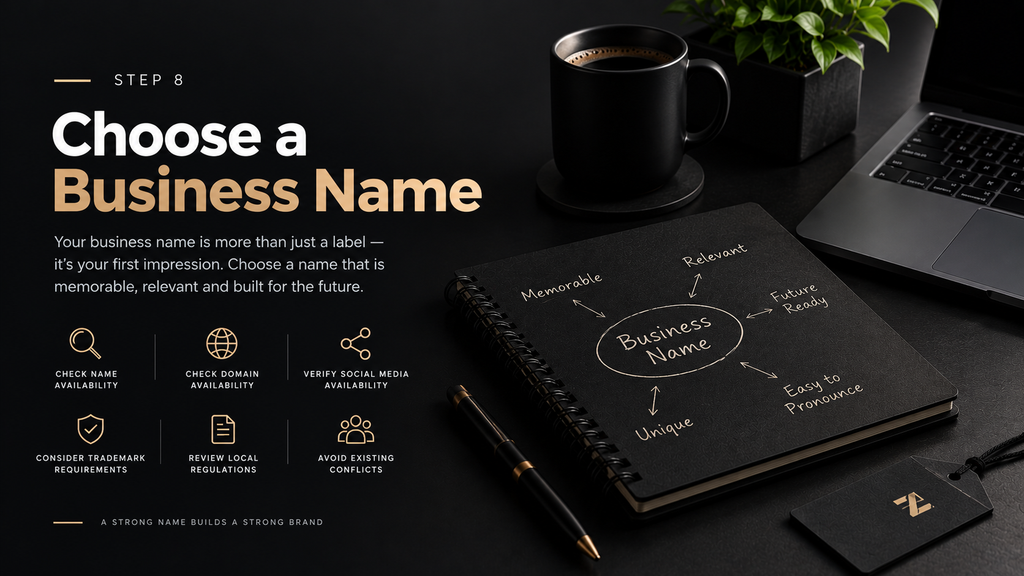
Your business name should be professional, memorable, and relevant to your brand.
Before committing to a name, check:
- Business name availability
- Domain availability
- Social media availability
- Trademark considerations
- Local registration requirements
- Potential conflicts with existing businesses
Choose a name that gives your business room to grow.
Avoid selecting a name that is so specific that it limits the company if you later expand into additional products, services, or markets.
9. Register Your Business
Once you have selected your structure and name, complete the necessary registration requirements in your jurisdiction.
Depending on where you operate, this may involve:
- Business registration
- Tax registration
- Business licenses
- Industry-specific permits
- Employer registration
- Sales tax or VAT registration
- Local permits
- Import or export registrations
The requirements vary significantly between countries, states, provinces, cities, and industries.
Create a checklist of the requirements that apply specifically to your business and complete them before beginning regulated activities.
10. Separate Business and Personal Finances
Keeping business and personal finances separate is an important part of professional financial management.
Set up appropriate business banking and accounting processes.
Track Your Business Finances
Keep records of:
- Revenue
- Operating expenses
- Payroll
- Taxes
- Inventory
- Invoices
- Subscriptions
- Equipment
- Marketing expenses
- Loans
- Other financial obligations
Accurate records help you understand how the business is performing and make financial reporting easier.
Consider using accounting software or working with a qualified accountant, particularly as your business becomes more complex.
11. Calculate Your Startup Costs
Before launching, determine how much money you actually need.
Typical startup costs may include:
- Business registration
- Equipment
- Website development
- Software
- Inventory
- Office or workspace
- Insurance
- Professional services
- Marketing
- Packaging
- Employee costs
- Initial operating expenses
Create two separate estimates:
One-Time Startup Costs
These are expenses you expect to pay when establishing the business.
Recurring Monthly Expenses
These are costs that continue after launch, such as software, salaries, rent, marketing, hosting, and utilities.
This distinction is important because many businesses require ongoing funding even after the initial launch.
It is also wise to maintain a reasonable cash reserve to help manage unexpected expenses and slower-than-expected sales.
12. Set Your Pricing Strategy
Pricing directly affects revenue, profitability, customer perception, and market positioning.
Start by understanding your costs.
Depending on your business model, consider:
- Production costs
- Labor
- Packaging
- Shipping
- Software
- Overhead
- Taxes
- Payment processing
- Marketing
- Customer support
Then research competitor pricing and customer expectations.
Your price should be based on more than simply copying competitors.
Consider the value you provide, your positioning, your costs, and the willingness of your target customers to pay.
Avoid setting prices too low simply to attract customers. Extremely low pricing can make profitability difficult and may communicate a different level of value than you intend.
13. Build Your Brand
A strong brand helps customers recognize and remember your business.
Your brand can include:
- Business name
- Logo
- Color system
- Typography
- Visual identity
- Brand voice
- Messaging
- Customer experience
Your branding should be consistent across your website, social media, packaging, advertising, emails, and other customer touchpoints.
However, branding is more than visual design.
Your reputation is built through the experience customers have with your company.
14. Build a Professional Online Presence
Most modern businesses benefit from having a professional online presence.
At a minimum, consider creating:
- A professional website
- Business email address
- Relevant social media profiles
- Business listings where appropriate
- Contact and inquiry channels
Your website should clearly communicate:
- What you offer
- Who you serve
- Why customers should consider you
- How your product or service works
- How customers can contact or purchase from you
Include clear calls to action and make sure the website works well on mobile devices.
For businesses that rely heavily on online discovery, search engine optimization can also help potential customers find your website through search engines.
15. Develop a Marketing Strategy
Having a great product does not guarantee customers will find it.
Create a marketing strategy based on where your target audience spends time and how they make purchasing decisions.
Marketing Channels to Consider
Potential channels include:
- Search engine optimization
- Content marketing
- Social media
- Email marketing
- Paid advertising
- Influencer partnerships
- Networking
- Referral programs
- Events
- Public relations
- Direct outreach
The right combination depends on your industry and audience.
Start with a small number of channels rather than trying to use every platform simultaneously.
Measure results and increase investment in strategies that produce meaningful business outcomes.
16. Create a Sales Process
Marketing creates awareness, while sales converts interest into customers.
Create a clear process for handling potential customers.
A basic sales process might include:
- Lead generation
- Initial contact
- Needs assessment
- Product or service presentation
- Proposal or quotation
- Follow-up
- Purchase
- Onboarding
- Follow-up support
Document your process so that customers receive a consistent experience.
For service businesses, professional proposals and contracts can also help establish expectations before work begins.
17. Build Your Business Operations
Operations are the systems that allow your business to deliver its products or services consistently.
Determine:
- How orders are received
- How products are produced
- How services are delivered
- How inventory is managed
- How customers receive support
- How payments are processed
- How suppliers are managed
- How quality is controlled
- How problems are handled
Document important processes where possible.
Good operational systems reduce mistakes and make it easier to grow the business.
18. Choose the Right Tools and Technology
Technology can improve efficiency and reduce administrative work.
Depending on your business, you may need:
- Accounting software
- Customer relationship management software
- Project management tools
- Communication platforms
- Inventory management
- Payment processing
- Website analytics
- Email marketing
- Cloud storage
- Cybersecurity tools
Choose technology based on actual business requirements rather than purchasing every tool available.
Too many disconnected systems can create unnecessary complexity.
19. Hire and Manage Employees Carefully
You may eventually need employees or contractors to support business growth.
Before hiring, determine:
- What work needs to be done?
- What skills are required?
- Can the work be automated?
- Should it be handled internally or externally?
- What can the business realistically afford?
Create clear job responsibilities and expectations.
Professional onboarding, communication, training, and performance management can help employees understand how their work contributes to the company’s objectives.
Make sure employment and contractor arrangements comply with applicable local laws.
20. Launch Your Business
Once the essential systems are ready, launch your business.
A launch does not have to be enormous.
You can begin with a controlled launch that allows you to test:
- Customer demand
- Pricing
- Marketing
- Sales process
- Product quality
- Customer service
- Operations
Collect feedback from your first customers and use it to improve the business.
Your first version does not need to be perfect. It needs to provide real value and create an opportunity for learning.
21. Track Key Business Metrics
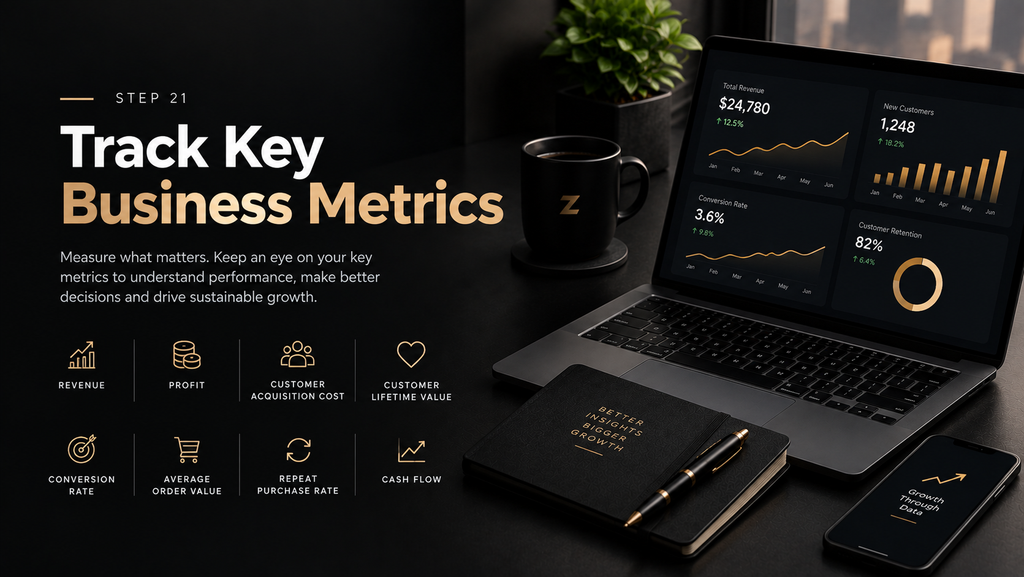
Once the business begins operating, monitor its performance regularly.
Important metrics may include:
- Revenue
- Gross profit
- Net profit
- Customer acquisition cost
- Customer lifetime value
- Conversion rate
- Average order value
- Repeat purchase rate
- Website traffic
- Lead volume
- Cash flow
- Customer retention
The specific metrics that matter depend on your business model.
Avoid focusing only on revenue. A business can generate substantial sales while still experiencing financial problems if expenses and cash flow are poorly managed.
22. Manage Cash Flow
Cash flow is one of the most important financial considerations for a growing business.
Monitor:
- Money coming into the business
- Money leaving the business
- Payment timing
- Outstanding invoices
- Recurring expenses
- Tax obligations
- Loan payments
- Inventory purchases
A profitable business can still face difficulties if it does not have enough cash available when bills become due.
Review your cash position regularly and maintain appropriate financial reserves where possible.
23. Listen to Your Customers
Your customers can provide some of the most valuable information available to your business.
Ask:
- What do customers like?
- What frustrates them?
- What features do they want?
- Why did they choose you?
- Why do potential customers decide not to buy?
- What could improve their experience?
Monitor reviews, support requests, surveys, conversations, and other feedback.
Customer feedback can reveal opportunities for new products, improved services, better marketing, and operational improvements.
24. Improve and Adapt
Starting a business is not a one-time project.
Markets change.
Customer expectations change.
Technology changes.
Competitors change.
Successful businesses continually evaluate their strategies and adapt when necessary.
Review your business regularly and ask:
- What is working?
- What isn’t working?
- Where are customers coming from?
- Which products are most profitable?
- Which expenses can be reduced?
- What problems are customers experiencing?
- What opportunities should we explore?
Use actual data and customer feedback to guide improvements whenever possible.
25. Create a Long-Term Growth Strategy
Once your business has established a stable foundation, consider how you want it to grow.
Growth opportunities may include:
- Launching new products
- Entering new markets
- Expanding geographically
- Increasing online sales
- Developing partnerships
- Hiring additional staff
- Automating processes
- Improving customer retention
- Introducing subscription services
- Expanding your marketing
The right growth strategy depends on your company’s resources and market opportunity.
Avoid expanding simply because growth sounds attractive. Sustainable growth requires sufficient demand, operational capacity, financial resources, and management capability.
Common Business Startup Mistakes to Avoid
New entrepreneurs often make avoidable mistakes.
Some common examples include:
- Starting without researching the market
- Trying to serve everyone
- Underestimating startup costs
- Ignoring cash flow
- Setting prices without understanding costs
- Spending too much on unnecessary tools
- Neglecting customer service
- Depending entirely on one marketing channel
- Failing to track financial performance
- Expanding too quickly
- Ignoring legal or tax requirements
Avoiding these problems does not guarantee success, but careful planning can reduce unnecessary risk.
Business Startup Checklist
Before launching your business, review the following checklist:
Business Planning
- Business idea defined
- Target audience identified
- Market research completed
- Competitors analyzed
- Business model developed
- Business plan prepared
Legal and Financial Setup
- Business structure selected
- Business name checked
- Required registrations completed
- Licenses and permits reviewed
- Business banking established
- Accounting system established
- Startup costs calculated
- Pricing strategy created
Branding and Marketing
- Brand identity developed
- Website launched
- Marketing strategy prepared
- Social media profiles created where appropriate
- Sales process established
Operations
- Operations documented
- Customer support process created
- Required tools selected
- Key performance metrics identified
- Launch plan prepared
- Financial reserves reviewed
Final Thoughts
Starting a business requires planning, research, financial discipline, and continuous improvement.
The process begins with identifying a genuine customer need and developing a practical solution. From there, entrepreneurs need to validate the opportunity, understand their market, establish a sustainable business model, complete the necessary legal and financial requirements, and build systems for marketing, sales, operations, and customer service.
The launch is only the beginning.
A sustainable business is built through consistent execution, responsible financial management, customer feedback, and the willingness to adapt as the market changes.
Whether you are starting a small local company or planning a larger venture, taking the process step by step can help transform an initial idea into a structured business with a clear path forward.