


Discover the differences between teamwork and working alone, including their advantages, disadvantages, productivity benefits, and when each work style may be useful.
Teamwork vs Working Alone: Which Is Better for Productivity?
Some people enjoy working with a team, sharing ideas, and solving problems together. Others prefer working alone because it gives them more control over their schedule, environment, and decisions.
So, what is better: working in a team or working alone?
The answer depends on the type of work, the goal, the people involved, and the individual’s working style. Teamwork can bring different skills and perspectives together, while working alone can provide more independence and focused time.
Research and workplace guidance also suggest that productivity is not simply about choosing between collaboration and isolation. The right balance can depend on the task. The American Psychological Association, for example, notes that productivity can include collaboration, information sharing, trust, flexibility, and individual thinking time.
In this guide, we’ll compare teamwork vs working alone, explore the advantages and disadvantages of both, and explain when each approach can be useful.
What Is Teamwork?
Teamwork means two or more people working together toward a shared goal.
In a team, individuals can divide responsibilities, exchange ideas, provide feedback, and use different skills to complete a project.
For example, creating a website might involve:
- A writer creating content
- A designer creating graphics
- An SEO specialist researching keywords
- A developer building the website
- A project manager organizing the work
Each person contributes something different to the final result.
Effective teamwork usually requires clear communication, shared goals, accountability, and respect between team members.
For more information, see this research on effective teamwork from the American Psychological Association.
What Does Working Alone Mean?
Working alone means completing a task independently, with limited collaboration or direct assistance from others.
This doesn’t necessarily mean completely avoiding other people. Someone working independently might still communicate with clients, managers, teachers, or colleagues when necessary.
Examples include:
- Writing an article
- Studying for an exam
- Designing a personal project
- Programming a small application
- Researching a topic
- Planning a business idea
Working alone can provide uninterrupted time to concentrate on a specific task.
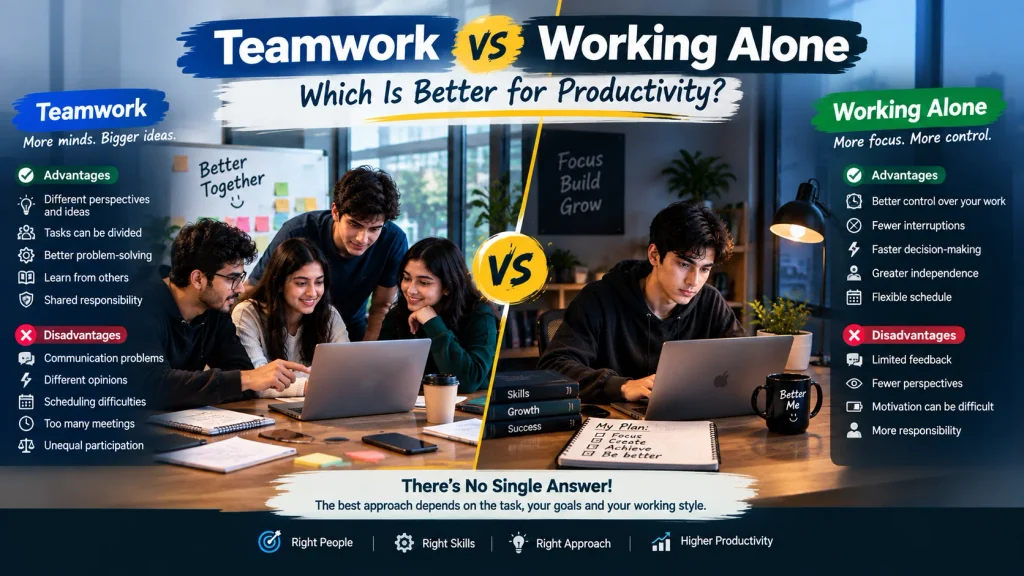
Advantages of Working in a Team

Teamwork can be particularly useful when a project requires different skills or perspectives.
1. Different Ideas and Perspectives
One person may approach a problem from one direction, while another person may see something completely different.
When people share ideas, they can discover possible solutions that might not have appeared during individual work.
Team collaboration can encourage brainstorming, innovation, and knowledge sharing.
2. Tasks Can Be Divided
Large projects can feel overwhelming when one person has to handle everything.
A team can divide a project into smaller responsibilities.
For example:
Website project →
Research → Writing → Design → Development → SEO → Testing
Instead of one person doing every task, different team members can focus on specific areas.
3. Easier Problem-Solving
When someone gets stuck, another team member may have the knowledge or experience needed to help.
Teamwork can therefore make complex problems easier to approach from multiple perspectives. Asana’s current workplace guidance identifies problem-solving and knowledge sharing among the benefits associated with effective collaboration.
4. Learning From Others
Teamwork can also be a learning opportunity.
A beginner working with an experienced person can learn new techniques, tools, and approaches.
This is especially useful for students and people starting their careers.
5. Shared Responsibility
A large project doesn’t necessarily have to depend on one person.
When responsibilities are clearly assigned, team members can contribute to different parts of the project and share accountability for the outcome.
Disadvantages of Working in a Team
Teamwork also has challenges.
1. Communication Problems
If team members don’t communicate clearly, mistakes and misunderstandings can occur.
A simple misunderstanding about a deadline can delay an entire project.
2. Different Opinions
Different perspectives can be useful, but disagreements can also slow down decision-making.
Teams need respectful communication and a clear way to make decisions.
3. Scheduling Difficulties
Getting several people together at the same time can be difficult, especially with remote or hybrid teams.
4. Too Many Meetings
Collaboration can become inefficient when people spend too much time in meetings instead of completing focused work.
Microsoft’s research on modern work has highlighted the importance of balancing collaboration with individual productivity and focused work.
5. Unequal Participation
Sometimes one person may contribute significantly more than another.
Clear roles, deadlines, and accountability can help reduce this problem.
Advantages of Working Alone
Working independently can be useful when a task requires concentration or personal decision-making.
1. Better Control Over Your Work
When working alone, you can decide how to organize your time and approach the task.
You don’t have to wait for another person before continuing.
2. Fewer Interruptions
Some tasks require deep concentration.
Writing, coding, studying, editing, and research can sometimes benefit from uninterrupted work periods.
3. Faster Decision-Making
When you’re working alone, you don’t need to wait for everyone’s approval before making a small decision.
This can make simple tasks move quickly.
4. Greater Independence
Working alone can help develop:
- Self-discipline
- Time management
- Decision-making
- Problem-solving
- Personal responsibility
These skills can be valuable for students, freelancers, entrepreneurs, and professionals.
5. Flexible Schedule
Independent workers can often organize their work around their most productive hours.
For example, someone who concentrates better in the morning can complete difficult tasks early in the day.
Disadvantages of Working Alone
Working independently also has limitations.
1. Limited Feedback
When you’re alone, you may not immediately have someone to review your idea or identify a mistake.
2. Fewer Perspectives
You have access mainly to your own knowledge and experience.
A second opinion can sometimes reveal an issue you didn’t notice.
3. Motivation Can Be Difficult
Without teammates, some people may find it harder to stay accountable.
4. More Responsibility
When you’re responsible for every part of a project, the workload can become heavy.
For example, someone running a website alone may have to handle:
Writing + SEO + Design + Development + Marketing + Customer Support
That can become difficult as the project grows.
Teamwork vs Working Alone: Key Differences
| Factor | Working in a Team | Working Alone |
|---|---|---|
| Ideas | Multiple perspectives | Individual perspective |
| Decision-making | Usually shared | Usually faster |
| Workload | Can be divided | Usually handled individually |
| Communication | Essential | Less communication required |
| Feedback | Easily available | May require outside review |
| Flexibility | Depends on team | Usually higher |
| Problem-solving | Collaborative | Independent |
| Accountability | Shared | Individual |
| Focus | Possible interruptions | Often easier to control |
| Learning | Learn from teammates | Learn independently |
Neither approach is automatically suitable for every situation. The best option depends on the task and circumstances.
Which Is Better for Students?
For students, both working styles can be useful.
Teamwork can be valuable for:
- Group assignments
- Presentations
- Projects
- Brainstorming
- Discussions
- Practical activities
Working alone can be useful for:
- Exam preparation
- Reading
- Writing
- Revision
- Research
- Completing individual assignments
A student could therefore use both approaches during the same project.
For example:
Group discussion → Individual research → Team review → Individual revision
This combines collaboration with focused individual work.
Students can also use free AI tools for students to support research, note-taking, writing, and productivity.
15 Best Free AI Tools for Students in 2026
Which Is Better for Business?
Businesses often require both teamwork and independent work.
A marketing team might collaborate on a campaign strategy while individual employees separately create articles, graphics, advertisements, or reports.
The important factor is matching the work style to the task.
For example:
Brainstorming → Teamwork
Writing first draft → Individual work
Reviewing ideas → Teamwork
Editing → Individual work
Final decision → Team discussion
This approach allows businesses to use collaboration where it adds value while protecting time for focused work.
How to Choose Between Teamwork and Working Alone
Ask yourself these five questions:
1. Does the task require different skills?
If yes, teamwork may be useful.
2. Do you need creative ideas?
A group brainstorming session can provide multiple perspectives.
3. Does the task require deep concentration?
If yes, individual focused work may be more suitable.
4. Do you need immediate feedback?
Working with others can make feedback easier to obtain.
5. Is the project too large for one person?
If the workload is substantial, dividing responsibilities among people may make the project more manageable.
The Best Approach May Be a Combination
For additional insights into workplace productivity and how teams can improve performance, see this workplace productivity research from APA.
The question doesn’t always have to be teamwork OR working alone.
In many situations, combining both approaches can work well.
A project might follow this workflow:
1. Team brainstorming
↓
2. Individual research
↓
3. Team discussion
↓
4. Individual focused work
↓
5. Team review
↓
6. Final individual improvements
This gives people time to collaborate while also allowing uninterrupted work.
The APA has similarly highlighted the importance of finding an appropriate balance between collaboration and individual “thinking time,” rather than treating one approach as universally applicable.
How to Improve Teamwork
If you work in a team, these simple practices can make collaboration smoother:
Set Clear Goals
Everyone should understand what the project is trying to achieve.
Define Responsibilities
Make sure each person knows what they are responsible for.
Communicate Clearly
Use simple messages and provide important information at the right time.
Respect Different Ideas
A different opinion doesn’t automatically mean a bad idea.
Use Shared Tools
Shared documents, task-management systems, and communication platforms can help teams stay organized.
Give Constructive Feedback
Focus on improving the work rather than blaming people.
Effective teamwork depends on factors such as communication, trust, shared accountability, and clear goals.
How to Work More Effectively Alone

If you prefer independent work, try these strategies:
Create a Daily Task List
Write down the most important tasks before starting.
Remove Distractions
Turn off unnecessary notifications and keep your workspace organized.
Use Time Blocks
Work for a focused period, then take a short break.
Set Deadlines
Give yourself realistic deadlines even when nobody else is monitoring your work.
Review Your Work
Before finishing, check your work for mistakes.
Ask for Feedback When Necessary
Working alone doesn’t mean you can never ask someone for help.
Teamwork vs Working Alone: Final Thoughts
So, is working in a team better than working alone?
There isn’t one answer that applies to every person or every task.
Teamwork can provide different perspectives, shared skills, collaboration, and support. Working alone can provide independence, flexibility, and focused time.
The most practical approach is to choose the method based on the work.
Use teamwork when:
- You need different skills
- You need brainstorming
- The project is large
- You need feedback
- Responsibilities can be divided
Work alone when:
- You need deep concentration
- The task is straightforward
- You need flexibility
- You can complete the work independently
- You want uninterrupted thinking time
For many students and professionals, the most useful workflow may be a combination of teamwork and individual work.
The goal isn’t simply to work with more people or work alone. The goal is to create a working process that helps you complete the right task effectively.
Frequently Asked Questions
Is teamwork better than working alone?
It depends on the task. Teamwork can help with collaboration, different perspectives, and dividing responsibilities, while working alone can provide focus and independence.
What are the benefits of working in a team?
Common benefits include sharing knowledge, dividing workloads, generating different ideas, improving problem-solving, and working toward a shared goal.
What are the benefits of working alone?
Working alone can provide greater control over your schedule, fewer interruptions, independent decision-making, and focused work time.
Is teamwork important for students?
Yes. Teamwork can help students develop communication, collaboration, problem-solving, and responsibility skills. Individual study is also important for tasks such as revision and focused learning.
Can teamwork and working alone be combined?
Yes. A project can use teamwork for brainstorming and feedback while using individual work for research, writing, design, or other focused tasks.