

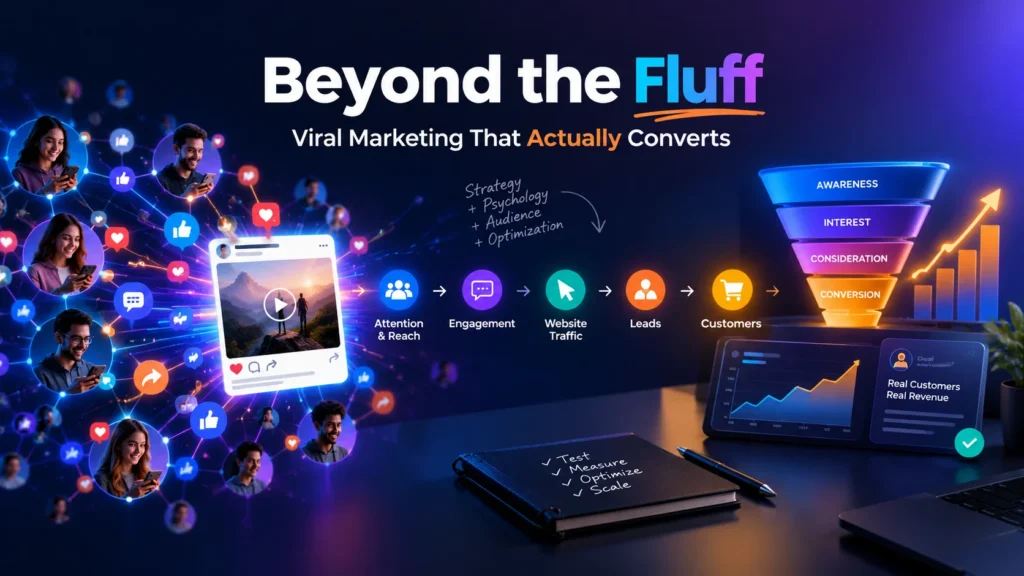
Beyond the Fluff: Engineering Viral Marketing Strategies That Actually Convert
I’ve spent years turning Zestwear.pk into a testing ground for high-level SEO, AI, and developer tools. If there is one thing that consistently frustrates me in our industry, it’s how “viral marketing” is sold as a mystical art form. Agencies pitch it as a mix of trendy TikTok audio, sheer dumb luck, and crossing your fingers.
That’s not how we operate here. We don’t rely on generic AI-generated fluff to build authority. Virality isn’t magic; it is math, system architecture, and applied psychology.
Today, I’m taking you under the hood of what actually makes a campaign tear through the internet, generate massive backlink velocity, and bring in retained users—not just fleeting eyeballs. We are going to break down the mechanics of viral growth from a technical and analytical perspective.
The Mathematical Reality of Virality: The K-Factor
Before we look at specific strategies, we have to look at the math. In software and growth engineering, we don’t guess if something is going viral. We calculate its Viral Coefficient, known as the K-factor.
The formula is brutally simple: K = i × c
- i = The number of invitations (or shares) sent by each new user.
- c = The conversion rate of those invitations into new, active users.
If your K-factor is below 1.0, your campaign is fundamentally a leaky bucket. You might get an initial spike from a paid push, but the organic sharing will eventually fizzle out. If your K-factor is above 1.0, you have achieved exponential, self-sustaining growth.
Play with the simulator below. Notice how hard it is to actually maintain a K-factor above 1.0. You have to aggressively optimize both the share rate and the conversion rate simultaneously.

Strategy 1: Engineering “Utility” Instead of Content
The modern web is completely saturated with written content. With the advent of LLMs, anyone can publish ten 2,000-word articles a day. If you want to go viral now, writing another “Top 10 Tips” listicle won’t cut it.
As a technical SEO, I know that 10x content is good, but 10x utility is better.
Instead of writing an article about how to audit a website, build a free, interactive Chrome extension or a web-based schema generator. Give away your margins. Take a tool that your competitors charge a monthly SaaS fee for, strip it down to its core functionality, and host it for free on your domain without requiring an email opt-in.
When you build utility, users don’t just consume it; they bookmark it. They share it on Reddit, Hacker News, and Stack Overflow. They embed links to it in their own company wikis. This creates a perpetual motion machine for organic backlinks and traffic that compounding interest over time, long after a traditional “viral video” would have faded into obscurity.
Strategy 2: Proprietary Data and the “Contrarian Truth”
To cut through the noise, you need leverage. In the digital publication space, leverage comes from proprietary data.
Journalists, industry bloggers, and major publications are always desperate for hard statistics to back up their articles. If you publish a generic opinion piece stating, “AI is changing how we search,” nobody cares.
However, if you scrape 10,000 SERPs (Search Engine Results Pages), analyze the data, and publish a report titled, “We Analyzed 10,000 Queries: AI Overviews Are Reducing Organic CTR by 14.3%,” you will trigger an industry-wide conversation.
The framework for data-driven virality:
- Find a consensus: Identify something everyone in your industry believes.
- Test it: Run a script, build a scraper, or survey a massive user base to test that belief.
- Publish the shock: Highlight the most contrarian, surprising data point in your headline.
When you provide unique data, you become the primary source. Every subsequent article written on that topic will be forced to cite your domain.
Strategy 3: Dynamic Infrastructure and Frictionless Sharing
You cannot achieve a high K-factor if sharing your content requires more than one second of cognitive load. Friction kills virality. This is where system architecture meets marketing.
Most marketers just slap a static “Share to Twitter” button on an article and call it a day. If you want true algorithmic acceleration, you need dynamic Open Graph (OG) tags.
When a user engages with one of your custom tools or calculators, the share URL shouldn’t just link back to the homepage. It should capture their specific state and dynamically generate an image showing their result.
Using edge computing (like Vercel’s OG Image Generation), you can programmatically generate share cards on the fly. If someone gets a massive score on your interactive quiz, the URL they share automatically renders a custom image on social media displaying their exact score. Humans are inherently ego-driven; we share things that make us look smart, successful, or unique. If your infrastructure automates that vanity, your share rate (i in our K-factor) will skyrocket.
Strategy 4: Algorithmic Arbitrage
Going viral isn’t about reaching “the internet” at large; it’s about hacking the specific distribution loops of individual platforms.
Google Discover, LinkedIn, X, and Hacker News all have entirely different algorithmic triggers:
- X (formerly Twitter): Rewards extreme velocity in the first 10 minutes. A post with 50 replies in 5 minutes will outrank a post with 500 replies accumulated over two days.
- LinkedIn: Heavily weights dwell time and “click to read more” interactions. Long-form, story-driven text with a document attachment (PDF carousel) keeps users on the platform, which the algorithm violently rewards.
- Google Discover: Triggers based on topical authority, high-resolution hero images (at least 1200px wide), and CTR from a highly personalized user feed.
To execute algorithmic arbitrage, you don’t post the same link everywhere. You sequence your launches. You drop the core research on your site, extract the most controversial stat for an X thread, turn the methodology into a LinkedIn carousel, and use your Discord community to inject initial velocity within the critical first hour of publication.
The Pros and Cons of Viral Growth
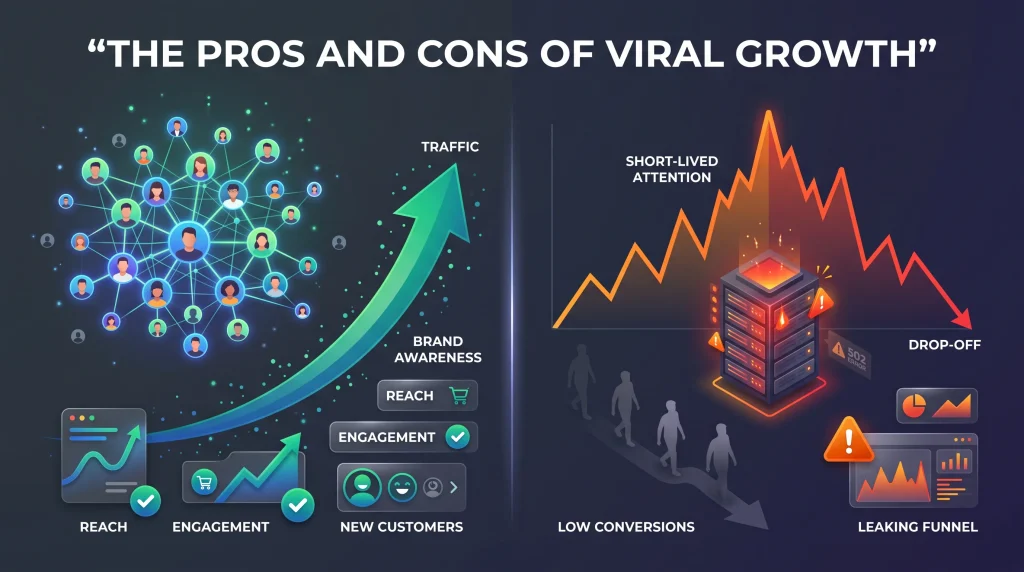
It’s easy to romanticize massive traffic spikes, but as anyone who manages technical architecture knows, virality breaks things. Let’s look at the reality objectively.
The Pros
- Category Authority Overnight: A single properly executed viral campaign can establish your brand as the definitive voice in a niche, shaving years off standard brand-building efforts.
- Backlink Velocity: The holy grail for SEO. A viral data piece will naturally attract high-DR (Domain Rating) editorial links from major publications that you couldn’t buy for tens of thousands of dollars.
- Exponentially Lower CAC: When users are acquiring other users for you, your Customer Acquisition Cost drops toward zero, allowing you to reallocate ad spend into better product development.
The Cons
- The Infrastructure “Hug of Death”: If you haven’t engineered your site for scale, going viral is a disaster. If your database queries aren’t optimized and you aren’t heavily leveraging CDNs (Content Delivery Networks) and Redis caching, a surge of 100,000 concurrent users will take your server offline, turning a massive opportunity into a 502 Bad Gateway error.
- Analytics Dilution: Viral traffic is notoriously low-intent. A massive influx of users who bounce after 5 seconds will absolutely destroy your historical analytics baseline, making it incredibly difficult to run accurate A/B tests or measure true conversion rates for months afterward.
- The Retention Trap: Acquiring a million users is useless if your product lacks stickiness. Viral marketing solves distribution, but it does not solve retention. If the core utility isn’t there, they won’t come back.
Traffic Trajectory Simulator
Actionable Tips and Tricks for 2026
If you are building a campaign today, here is where you need to focus your technical and strategic resources:
- Track "Dark Social" Ruthlessly: The vast majority of sharing no longer happens on public timelines. It happens in Slack channels, Discord servers, WhatsApp groups, and iMessage. Standard Google Analytics will bundle this as "Direct Traffic." Combat this by appending subtle hash-fragments or utilizing clipboard-hijacking (gracefully) to append UTM parameters when someone copies your URL.
- Micro-Interactions Over Passive Reading: Users have zero attention span for walls of text. Break up your analytical depth with interactive state-changes. Calculators, sliders, light/dark mode toggles, and reveal-on-scroll elements keep the user's cursor moving, which increases time-on-page and signals quality to search engines.
- The "Trojan Horse" API: If you build a great tool, package its core functionality into a simple API. Let other developers integrate your tech into their sites with a mandatory "Powered by Zestwear" backlink. You essentially turn other developers into your marketing team.
The Bottom Line
Viral marketing isn't a substitute for a good product, and it certainly isn't an accident. At Zestwear.pk, we view it as a strict engineering discipline.
Stop trying to guess what the algorithm wants or what content might "trend." Start building unique data sets, engineering high-utility micro-tools, and removing every ounce of friction from your sharing architecture. When you treat marketing like software development, the growth takes care of itself.