
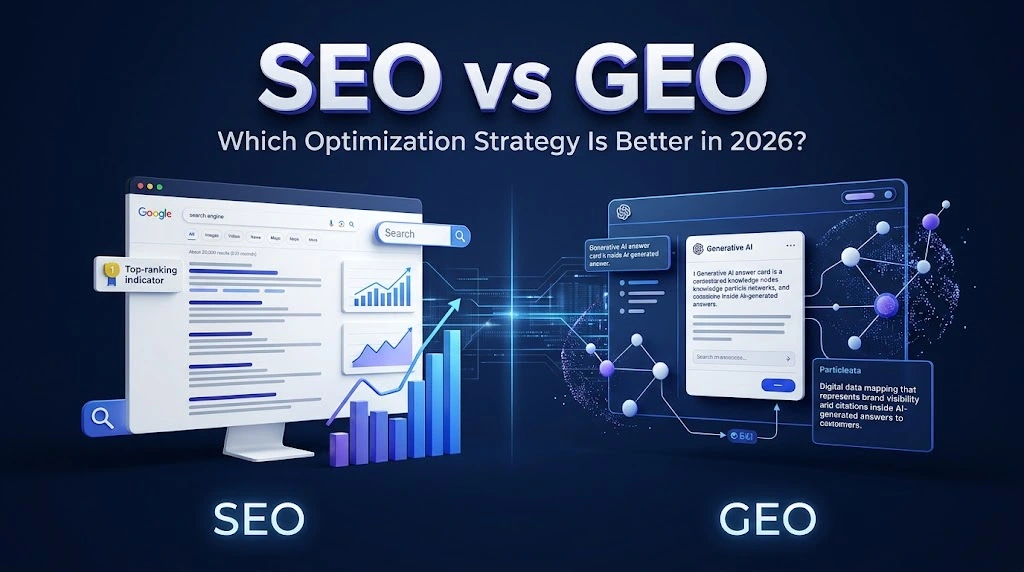
SEO vs GEO: Which Optimization Strategy Is Actually Better in 2026?
For over two decades, digital growth followed a straightforward formula: target relevant keywords, build domain authority through backlinks, maintain technical site health, and claim top real estate on Google’s ten blue links.
That formula is no longer complete.
With the mass adoption of OpenAI’s ChatGPT, Google AI Overviews, Gemini, and Perplexity, web discovery has split into two distinct tracks: traditional search and conversational answer generation. This shift has introduced a fierce debate among marketers, founders, and content teams: SEO (Search Engine Optimization) vs. GEO (Generative Engine Optimization)—which strategy is better?
Should you keep your budget anchored in classic search engine mechanics, or pivot entirely toward winning citations inside AI models?
The reality is that GEO is not replacing SEO; it is an evolution that sits directly on top of it. To make an informed strategic decision, you must understand how both systems operate, where they differ, and why winning in modern search requires a dual-track approach.
1. Defining the Mechanics: SEO vs. GEO
Before comparing outcomes, it helps to understand how each framework processes and surfaces web content.
┌────────────────────────────────────────────────────────┐
│ DIGITAL SEARCH FLOW │
└────────────────────────────────────────────────────────┘
│
┌───────────────┴───────────────┐
▼ ▼
┌───────────────────┐ ┌───────────────────┐
│ TRADITIONAL SEO │ │ GENERATIVE GEO │
├───────────────────┤ ├───────────────────┤
│ Crawl & Index │ │ Retrieval (RAG) │
│ Keyword Matching │ │ Entity Synthesis │
│ Rank Links │ │ Inline Citation │
│ Drive Clicks │ │ Recommend Brand │
└───────────────────┘ └───────────────────┘
Search Engine Optimization (SEO): Ranking Pages for Clicks
- Primary Objective: Rank individual URLs on Search Engine Results Pages (SERPs) for target keyword queries.
- Core Mechanics: Keyword density, title tags, heading structures (H1–H3), PageSpeed, internal link architecture, and backlink authority.
- Primary Outcome: Direct organic sessions, web page impressions, and traditional click-through traffic.
Generative Engine Optimization (GEO): Earning Citations & Recommendations
- Primary Objective: Position your brand, data, or product to be synthesized, quoted, and cited within AI-generated responses.
- Core Mechanics: Retrieval-Augmented Generation (RAG) readiness, high “Information Gain,” entity consistency across third-party web platforms, clear prose structure, and authoritative sourcing.
- Primary Outcome: Inline citation links, brand inclusion in AI shortlists, and high-converting referral visitors.
2. Head-to-Head Comparison: SEO vs. GEO
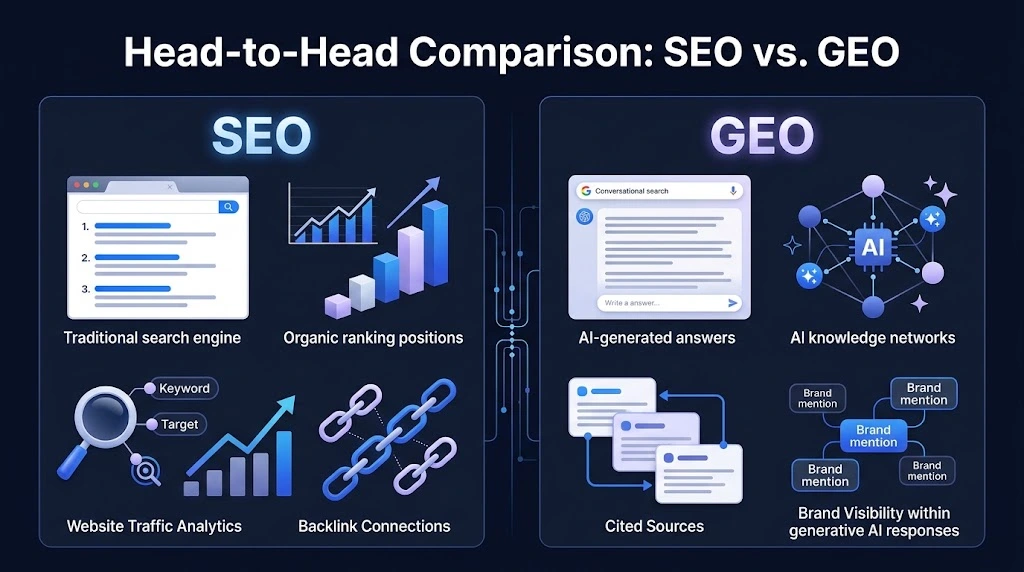
Understanding where each discipline excels allows you to deploy resources effectively rather than chasing vague industry buzzwords.
| Comparison Vector | Traditional SEO | Generative Engine Optimization (GEO) |
| Primary Target | Search engine crawlers (Googlebot, Bingbot) | Large Language Models (ChatGPT, Claude, Gemini, Perplexity) |
| User Intent Type | Short-to-mid tail queries (“best cms for e-commerce”) | Complex, multi-variable prompts (“Compare headless CMS platforms for a mid-market retailer with Shopify sync”) |
| Content Format | Scannable articles optimized for human skim-reading | Fact-dense, structured prose easily parsed by LLM retrieval chunks |
| Traffic Characteristics | Higher overall click volume; higher bounce rate | Lower overall click volume; significantly higher conversion intent |
| Off-Page Strategy | Backlinks and domain authority metrics (DA/DR) | Entity alignment, sentiment across Reddit/Quora/review hubs, and brand mentions |
| Measurement Tools | Google Search Console, Ahrefs, Semrush | Dedicated AI citation tracking and brand-mention analytics |
3. Which Framework Is Better?
Declaring one framework “better” than the other misses how modern retrieval engines actually source information.
The Case for SEO: The Unshakeable Foundation
You cannot execute a successful GEO strategy on a site with broken technical SEO. Studies tracking AI citation behavior consistently show that AI search engines overwhelmingly cite domains that already rank in top organic Google positions. Search crawlers must be able to discover, render, and index your pages before an LLM’s retrieval system can pull data from them.
Without foundational technical SEO, your site is effectively invisible to AI discovery engines.
The Case for GEO: Capturing High-Intent Conversions
While classic organic click-through rates have declined due to zero-click AI summaries, AI-referred traffic converts at a much higher rate than generic organic search traffic. When an AI assistant recommends a specific tool or vendor after analyzing a complex user prompt, the user clicking that citation link is already deep in the consideration phase. GEO helps you win those high-value recommendations.
The Verdict
- SEO wins on Foundation & Technical Health: It keeps your site indexed, structured, and accessible.
- GEO wins on Future Discovery & Intent: It ensures your brand isn’t summarized out of the conversation when users ask AI for direct answers.
The bottom line: SEO gets your content indexed; GEO gets your content recommended.
Building a lean digital infrastructure is essential for both search indexation and AI retrieval speed. Read our technical guide on performing a complete CMS database and media audit to eliminate site clutter and boost crawl performance.
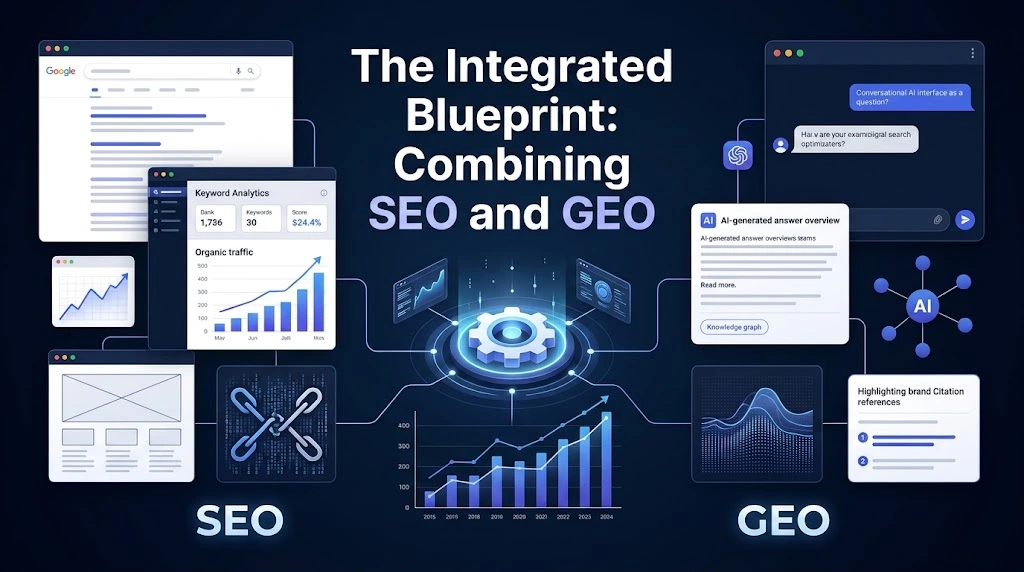
4. The Integrated Blueprint: Combining SEO and GEO
Instead of treating these as competing strategies, run this dual-track optimization workflow across every piece of content you produce:
1. Adopt the BLUF (Bottom Line Up Front) Format
Begin every main heading section with a direct, 2-to-3 sentence clear statement before expanding into deep detail. This provides a clean answer block for AEO/GEO chunk extraction while serving traditional human readers.
2. Focus on “Information Gain”
AI models skip pages that simply paraphrase what ten other blogs already say. To earn GEO citations, include original benchmark metrics, proprietary survey results, expert quotes, or unique case studies.
3. Implement Comprehensive Schema Markup
Use structured data (Article, Organization, Product, FAQPage) written in clean JSON-LD. This bridges the gap between traditional crawlers and machine-learning models, providing unambiguous context about your brand.
4. Build Off-Page Entity Signals
Generative models validate your site’s claims by checking consensus across the broader web. Ensure your brand, leadership, and product offerings are consistently described on third-party channels, including Reddit, industry directories, review platforms, and digital publications.
To monitor real-time search trends and query shifts globally, keep track of official data points on Google Trends.
Pre-Publishing Audit Checklist
Run your content through this checklist to ensure it satisfies both search algorithms and generative models:
- [ ] SEO Verification: Is the page crawlable, fast, mobile-friendly, and optimized around a logical keyword group?
- [ ] AEO Extraction Check: Does every major H2 contain a clear 40–60 word direct answer immediately below the header?
- [ ] GEO Citation Check: Does the piece include original data, expert commentary, or proprietary research that an AI cannot generate from its base training data?
- [ ] Entity Validation: Are key terms, author details, and brand references backed by structured JSON-LD schema?