
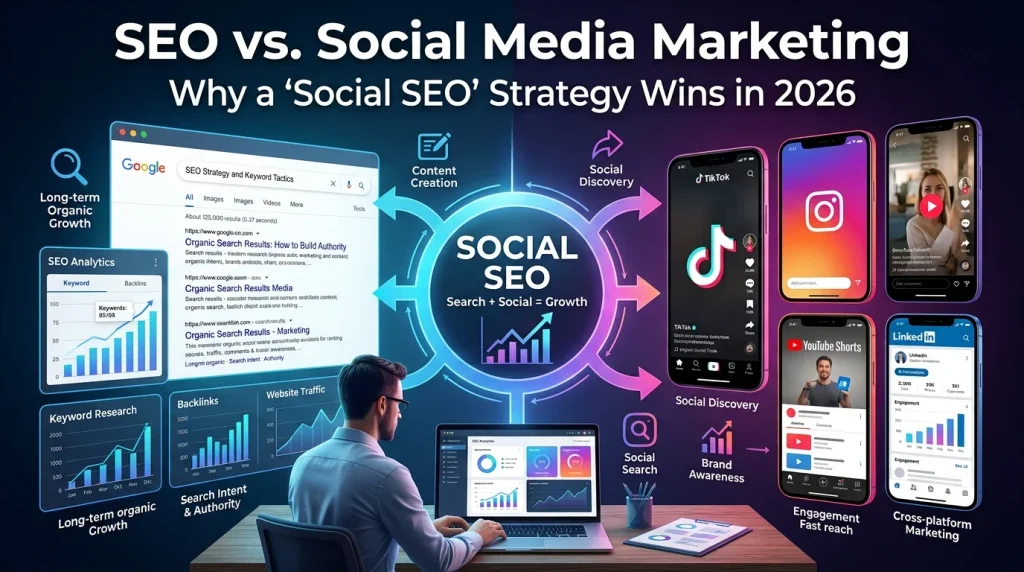
Confused about SEO vs. Social Media Marketing? Discover why combining them into a hybrid “Social SEO” strategy is the ultimate key to business growth, organic discovery, and dominating digital marketing in 2026.
SEO vs. Social Media Marketing: Why a “Social SEO” Strategy Wins in 2026
For decades, digital marketers, agency owners, and small business founders have debated where to invest their limited marketing budgets: SEO or social media marketing. Historically, this debate was framed as a strict binary choice. You either invested in the slow, steady compounding growth of traditional Search Engine Optimization (SEO), or you poured your resources into the fast, highly engaging, but often fleeting world of social media content.
However, as we navigate through 2026, the digital landscape has fundamentally shifted. The once-clear lines between a traditional search engine (like Google or Bing) and a social networking platform (like TikTok, Instagram, or LinkedIn) have blurred entirely. If your business is still treating SEO and social media as two completely separate departments operating in silos, you are missing out on the most significant opportunity for organic discovery in modern digital marketing.
Here is a deep dive into why the age-old debate of SEO vs. Social Media Marketing is officially dead, and why adopting a comprehensive, hybrid “Social SEO” strategy is the ultimate blueprint for sustainable business growth today.
The Traditional Divide: Search Intent vs. Social Discovery
To truly understand the modern shift, we must first analyze how these two distinct marketing channels traditionally functioned, and why marketers kept them separated for so long.
The Mechanics of Traditional SEO (Google, Bing)
Traditional SEO has always been built on active user intent. A user realizes they have a problem, navigates to a search engine, and types in a highly specific query (e.g., “best local SEO agency in Chicago” or “how to fix a leaking kitchen sink”).
The Strengths of Traditional SEO:
- High-Intent Traffic: SEO captures users at the middle or bottom of the sales funnel. By the time they search, they are actively looking for a solution, making them highly qualified leads.
- Evergreen Value: A well-optimized, comprehensive blog post can rank on the first page of Google for years, driving continuous, passive traffic without requiring daily content creation.
- Trust and Authority: Ranking at the top of Google signals to consumers that your brand is an established, trustworthy authority in its industry.
The Weaknesses of Traditional SEO:
- Slow Results: It can take months (sometimes up to a year) to see a return on investment (ROI) from an SEO campaign.
- High Competition: With millions of websites vying for the top spot, breaking into saturated markets requires significant time, technical skill, and financial resources.
The Mechanics of Traditional Social Media Marketing
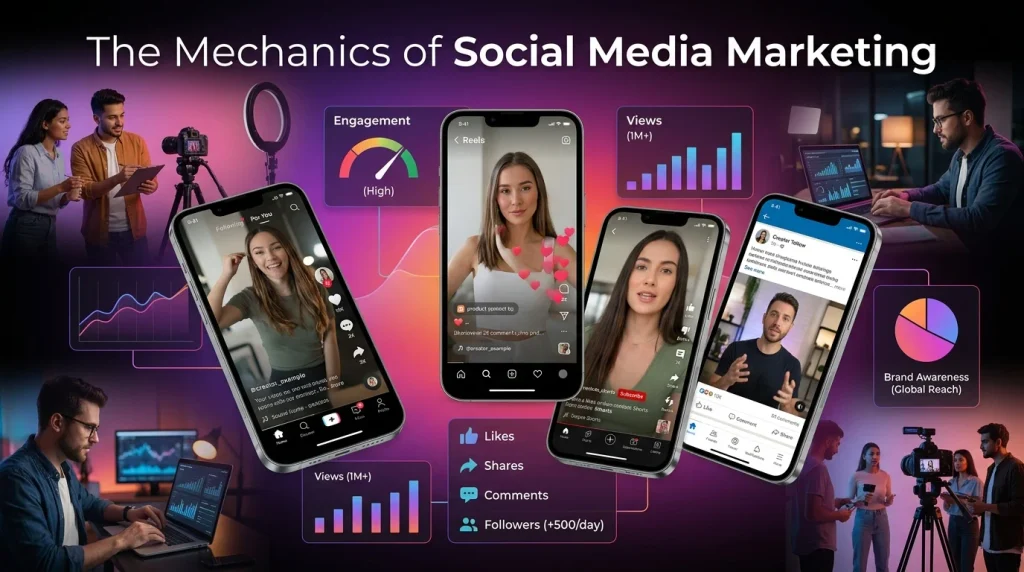
Conversely, traditional social media marketing has always been built on passive discovery. Users open platforms like Facebook, Instagram, or X (formerly Twitter) to be entertained, catch up with friends, or kill time.
The Strengths of Social Media Marketing:
- Instant Gratification and Speed: A clever post can go viral overnight, putting your brand in front of millions of eyeballs instantly.
- Brand Personality: Social media allows a business to showcase its human side, building emotional connections and fostering a loyal community.
- Top-of-Funnel Awareness: It excels at introducing your brand to people who didn’t even know they had a problem your product could solve.
The Weaknesses of Social Media Marketing:
- Ephemeral Content: The lifespan of a social media post is incredibly short. A tweet or an Instagram Story loses its momentum within hours, requiring a relentless, exhausting content treadmill.
- Low Initial Intent: Because you are interrupting their scroll, users are rarely in a “buying mood” when they first encounter your brand on social media.
The 2026 Shift: The Rise of the “Social Search Engine”
In the past, you needed SEO to capture existing demand and social media to create new demand. Today, those distinct user behaviors are overlapping in ways we have never seen before.
Consumer behavior has rapidly evolved. A massive percentage of global internet users—particularly Gen Z and Millennials, but increasingly older demographics as well—now use visual platforms as their primary search engines. When a 24-year-old wants a restaurant recommendation for an upcoming trip, they rarely type it into Google and read text-heavy reviews. Instead, they open TikTok or Instagram and search “best hidden restaurants in [City]” to see visually engaging, user-generated video content of the actual food and atmosphere.
Why Social Search is Taking Over
- Craving Authenticity over Corporate Polish: Modern consumers are deeply skeptical of overly optimized, faceless corporate websites. They want to see real people using real products. Video search results on social platforms provide that raw, unfiltered proof of life.
- The Need for Visual Context: Queries related to fashion, food, travel, DIY tutorials, and fitness are inherently visual. Social media serves these results faster and more effectively than traditional text-based search engines. In fact, [Google’s own internal data has shown] that nearly 40% of young people go to TikTok or Instagram instead of Google Maps or Search when looking for a place for lunch
- Google’s Algorithmic Adaptation: Google has recognized this shift and panicked. To prevent losing market share to social media, and to compete with new generative search engines—which requires a dedicated [AI search optimization strategy]—Google is now heavily integrating TikToks, Instagram Reels, and YouTube Shorts directly into its traditional search results
This final point is crucial: An optimized social media video can now rank on the native social platform and on the first page of Google simultaneously.
What is “Social SEO”?
Social SEO is the strategic practice of optimizing your social media profiles, video content, images, and captions so that your brand consistently appears when users actively search for solutions within those social platforms.
It is the marriage of traditional SEO keyword research and modern social media content creation. Instead of relying purely on the algorithmic “For You” page to push your content to a passive audience, Social SEO ensures your content is actively pulled in by users searching for specific answers.
The 7-Step Blueprint for a Winning Social SEO Strategy
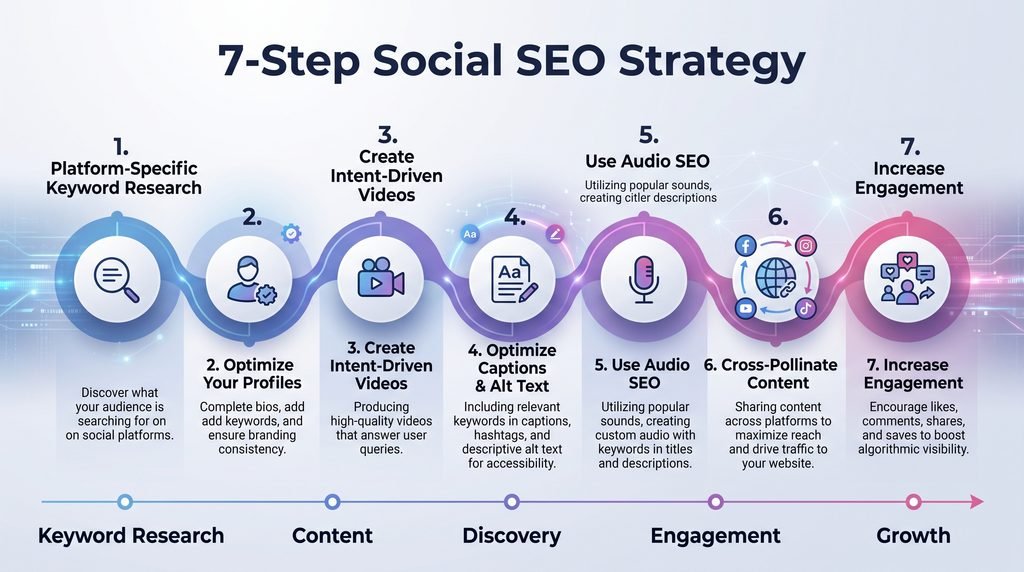
To capitalize on this massive shift and ensure your website is primed for maximum organic growth (which is also vital if you are looking to monetize via AdSense), you must stop posting purely for “viral” engagement. Here is a comprehensive, step-by-step guide to executing a flawless Social SEO strategy in 2026.
1. Conduct Platform-Specific Keyword Research
You cannot just take your Google SEO keywords and paste them into TikTok. Users search differently depending on the app.
- Action Step: Use the native search bars on TikTok, YouTube, and Instagram. Type in your broad industry term and see what auto-populates. These auto-suggestions are exact queries your target audience is searching for today. Use tools that now track social search volume alongside traditional search volume to build a robust keyword matrix.
2. Optimize Your Profiles Like Landing Pages
Your social media profile is no longer just a place for a witty quote or a vague mission statement. It is essentially your brand’s homepage meta description.
- Action Step: Ensure your Instagram, TikTok, X, and LinkedIn bios clearly state what you do using high-ranking industry keywords. If you are a local real estate agent, do not just write “Helping you find your dream home.” Write: “Chicago Luxury Real Estate Agent | Condos & Single Family Homes in IL.” This makes your actual profile rank higher when users search for Chicago real estate.
3. Create Intent-Driven, Educational Short-Form Video
Stop chasing random trending audio and irrelevant dance challenges. To build a sustainable asset library, create content that directly answers your customers’ most pressing questions.
- Action Step: If you run a digital marketing agency, create a continuous series of Reels or Shorts titled, “How to do keyword research in 2026,” or “3 reasons your website isn’t converting.” This type of query-based content has a remarkably long shelf life. It will continue to gather views, shares, and saves months later through search discovery.
4. Implement Deep-Text Optimization (Captions & Alt Text)
While arbitrary hashtags used to rule the world, platform algorithms have become incredibly sophisticated. Algorithms now utilize Natural Language Processing (NLP) to read your captions and understand the deep context of your post.
- Action Step: Stop writing vague, two-word captions. Write detailed, descriptive micro-blogs (100 to 300 words) that naturally incorporate your target keywords, LSI (Latent Semantic Indexing) keywords, and clear takeaways. Furthermore, always utilize the “Alt-Text” feature when uploading images. This tells the algorithm exactly what the image depicts, making it indexable.
5. Leverage “Audio SEO” (Speak Your Keywords)
Because platforms like TikTok, Instagram, and YouTube auto-transcribe audio to generate closed captions, their search algorithms are actively “listening” to what you say.
- Action Step: Speak your primary target keywords clearly and naturally within the first three to five seconds of your video. If the video is about email marketing software, ensure you verbally say, “Here is the best email marketing software for small businesses in 2026,” right at the hook. The algorithm reads this transcript and indexes the video accordingly.
6. Cross-Pollinate for Maximum Authority
To build a moat around your brand, you must connect your social SEO efforts with your traditional website SEO.
- Action Step: When you write a comprehensive 2,000-word blog post for your website, embed your relevant YouTube Shorts, TikToks, or Instagram Reels directly into the body of the article. This drastically increases the “Time on Page” metric for your website (a major ranking factor for Google) while simultaneously driving high-quality, external website traffic to your social media videos (a major ranking factor for social algorithms).
7. Treat Engagement as a Ranking Factor
In traditional Google SEO, backlinks are the currency of authority. In Social SEO, saves, shares, and watch time are the currency.
- Action Step: Optimize your content for the “Save” and the “Share.” Instead of just asking for a “Like,” encourage users to save the video for future reference (e.g., “Save this checklist for your next website audit”). A high save rate tells the algorithm that your content is a valuable resource, pushing it higher in the platform’s search results.
Measuring Success: KPIs for a Hybrid Strategy
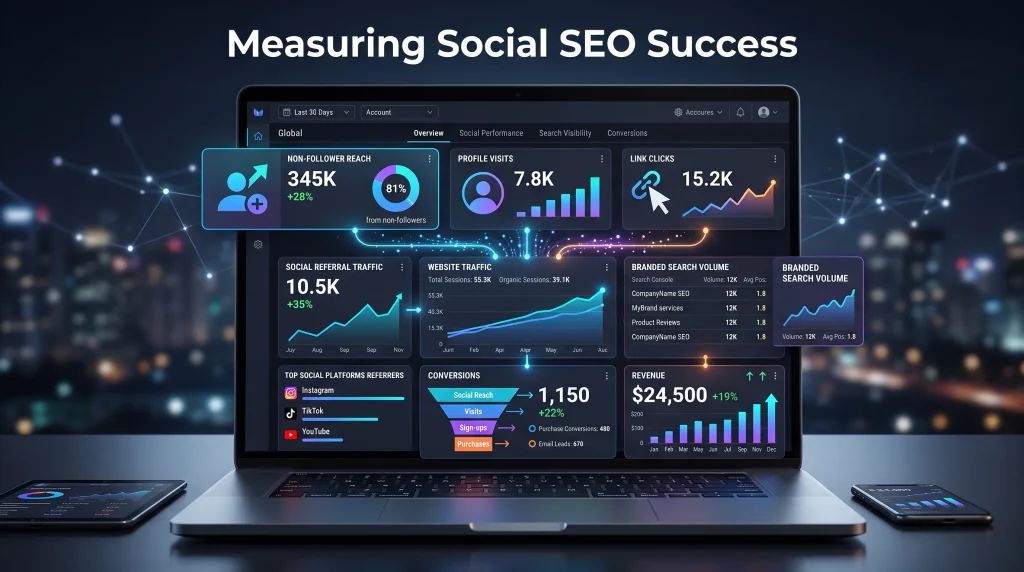
If you are running a business or attempting to monetize a high-traffic blog, you need to prove that this hybrid strategy is working. You can no longer rely on vanity metrics like “follower count.” Focus on these Key Performance Indicators (KPIs):
- Non-Follower Reach: Look at your social analytics to see what percentage of your viewers do not follow you. A high non-follower reach indicates that your content is successfully ranking in search and algorithmic discovery feeds.
- Profile Visits and Link Clicks: Are the people finding your social content actually transitioning to your website? Track the click-through rate (CTR) on your link-in-bio.
- Branded Search Volume: Use Google Search Console to monitor how many people are typing your exact brand name into Google. As your Social SEO strategy takes off, you should see a direct increase in people Googling your brand after discovering you on social media.
- Conversions/AdSense Revenue: Ultimately, track if this cross-pollinated traffic is leading to higher AdSense RPMs (Revenue Per Mille), more newsletter signups, or increased product sales on your main site.
Conclusion: Stop Choosing, Start Combining
When it comes to the great debate of SEO vs. Social Media Marketing in 2026, the answer is unequivocally clear: it is no longer one or the other. In fact, choosing to specialize in only one is a recipe for stagnation. Neither channel is universally better; rather, they are two halves of the same digital ecosystem.
Traditional website SEO provides long-term stability, captures high-intent buyers, and establishes unshakable industry authority. Meanwhile, social media humanizes your brand, builds a loyal community, and capitalizes on the modern user’s desire for visual search.
By dissolving the walls between these two disciplines and combining them into a cohesive, aggressive Social SEO strategy, you ensure your business is visible everywhere your customers are looking. Whether they are casually scrolling their feeds on a Sunday afternoon, searching for video tutorials on TikTok, or actively hunting for a B2B software solution on Google, your brand will be there, waiting to provide the exact answer they need.