

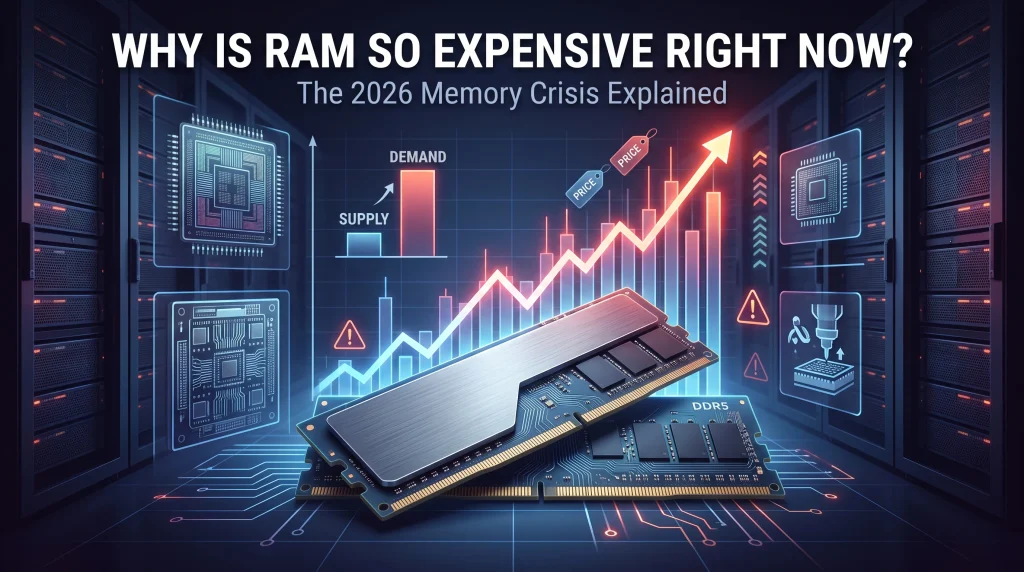
Why Is RAM So Expensive Right Now? The 2026 Memory Crisis Explained
If you had told me when I built my first custom rig five or six years ago that I’d be stressing over memory prices in 2026, I would have laughed. I entered the PC building space right around the tail end of the great GPU shortage of 2020-2021. Back then, we were fighting bots and scalpers just to get a mid-tier graphics card, but RAM? RAM was the easy part. You could casually throw a highly binned 32GB kit of DDR4 into your shopping cart for under $100 and not even blink. It was cheap, abundant, and completely stress-free.
Fast forward to today, and the landscape is unrecognizable. If you are planning a PC build right now, you’ve probably stared at your digital shopping cart in absolute disbelief. Standard 32GB DDR5 kits that were hovering around $120 a couple of years ago are now regularly sitting between $400 and $600. Even budget builds are being crippled by the cost of essential system memory.
So, what exactly is going on? Why is RAM so painfully expensive right now, and when can we expect the market to return to normal? Let’s dive into the silicon realities of 2026, the artificial intelligence boom, and why your gaming PC is actively competing with massive corporate data centers.
The Root Cause: AI Just Ate Your RAM
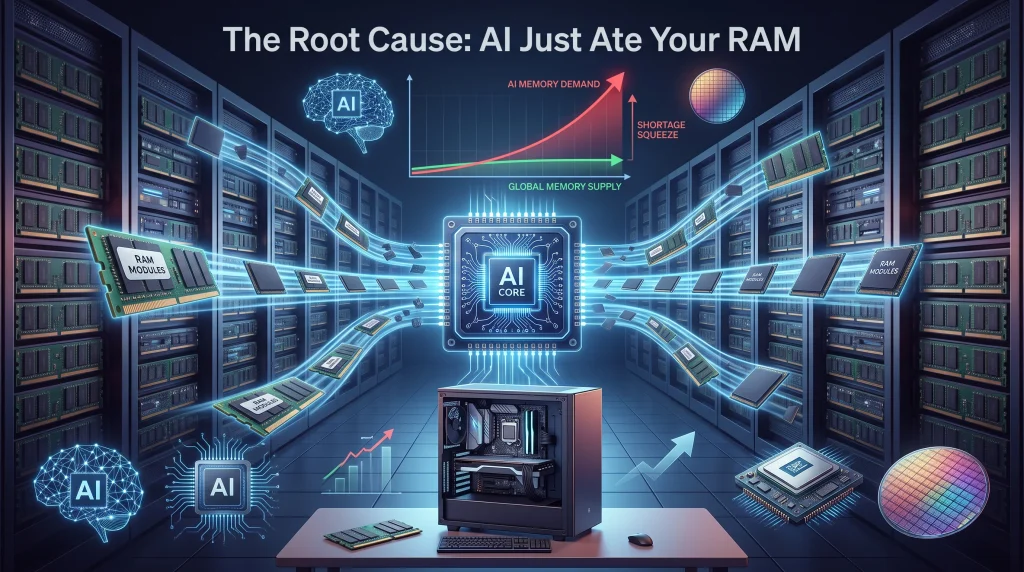
The explosive price hikes we are seeing across the PC component market come down to one specific, massive driver: Artificial Intelligence. But it’s not just “AI” as a buzzword; it’s the physical, hardware-level requirements of training next-generation large language models.
Modern AI data centers require specialized, ultra-high-capacity, high-speed memory to feed data to massive GPU clusters. This memory is known as HBM (High-Bandwidth Memory). Currently, the global memory manufacturing market is essentially a triopoly, controlled by three giants: Samsung, SK Hynix, and Micron. These three companies produce over 95% of the world’s DRAM.
Right now, these manufacturers have aggressively shifted their fabrication capacity away from standard consumer RAM (DDR4 and DDR5) and heavily toward HBM. In fact, industry tracking shows wholesale DDR5 contract prices rising sharply due to this tight supply and robust AI server demand. HBM profit margins are estimated to be five to ten times higher than standard consumer memory. When major tech giants are writing blank checks to secure HBM for their AI servers, memory manufacturers are naturally going to prioritize those orders over the memory meant for our gaming motherboards.
The “Wafer Math” and the 3x Squeeze
To really understand why the supply of consumer RAM has dried up so completely, you have to understand the manufacturing process. Silicon is processed in massive discs called wafers.
Creating High-Bandwidth Memory is incredibly complex and resource-intensive. HBM involves stacking multiple memory dies on top of each other and connecting them with microscopic vertical wires called through-silicon vias (TSVs). Because of the complexity and the current defect rates (yields), producing just one fully functional wafer of HBM consumes the equivalent clean-room time, resources, and raw silicon of three to four normal DDR5 DRAM wafers.
Every time SK Hynix or Micron converts a factory line to feed the AI server demand, they aren’t just removing one unit of consumer RAM from the market; they are removing three or four. This massive compression of standard PC memory from the global supply chain has created an artificial scarcity unlike anything we’ve seen since the crypto-mining boom.
DDR5 Prices Have Skyrocketed (And Laptops Aren’t Safe)
The resulting supply squeeze has caused PC memory prices to explode at a terrifying rate. Throughout the last 18 months, DDR5 contract prices—the wholesale prices that brands like Corsair, G.Skill, and Kingston pay to the big three manufacturers—have risen sharply and consistently.
In the retail market, this translates to agonizing price tags for system builders. We are seeing year-over-year average price increases nearing 500% for some high-capacity DDR5 kits. To put that in perspective: a standard 64GB (2x32GB) DDR5-5600 kit that would have cost you under $200 last summer is now demanding over $1,100. It is a 5x multiplier on a component that used to be a fairly boring and predictable line item in a PC build budget.
This isn’t just a desktop builder’s problem, either. The mobile market is feeling the exact same squeeze. High-performance gaming laptops and mobile workstations rely on SODIMM memory, and those specific laptop DDR5 memory prices have surged as much as 6X in the last 12 months. Memory is no longer a cheap afterthought; it has become a primary budget constraint, often forcing builders to drop down to 16GB of slower memory—a massive bottleneck for modern gaming and productivity in 2026.
The Great DDR4 Price Inversion: An Unexpected Nightmare
You might think the logical workaround to this DDR5 crisis would be sticking with a solid, older DDR4 platform. Motherboards that support DDR4 are still floating around, and millions of users are still on the AM4 or LGA1700 platforms. Surely, older tech is cheaper, right?
Wrong. Welcome to the great DDR4 price inversion.
To free up as much cleanroom space and resources as possible for high-margin HBM and the newer, more profitable DDR5, memory foundries practically halted DDR4 production, slashing it to below 15% of its previous historical output. However, because there are still tens of millions of legacy systems globally in enterprise environments, schools, and homes that require DDR4 for repairs and upgrades, demand didn’t drop as fast as supply.
This sudden, artificial scarcity caused remaining DDR4 stock prices to surge. In many regions today, a high-quality 32GB DDR4-3600 kit is actually more expensive than an entry-level DDR5 kit. The budget-builder safety net has been completely pulled out from under us.
My Advice: How to Survive the 2026 PC Market
Having navigated the hardware market for over half a decade, I’ve learned a few survival tactics when things get this volatile. If you absolutely must build or upgrade a PC right now, here is how you should approach your memory purchase:
- Do Not Overbuy Capacity: In 2024, the mantra was “just buy 64GB, it’s cheap.” Stop doing that. Assess exactly what you need. If you are strictly gaming, 32GB is still the sweet spot. Do not buy 64GB unless your professional workload (video editing, 3D rendering) heavily demands it.
- Ignore the “Silicon Lottery” Speeds: Chasing the absolute fastest memory (like DDR5-8000+) is a fool’s errand right now. The price premium for top-tier binned memory is astronomical. Settle for the sweet spot—around DDR5-6000 to 6400 with decent timings. The 1-2% frame rate difference in games is not worth an extra $200.
- Check the Used Market (Carefully): The used market is currently a goldmine, populated by people parting out systems. Memory rarely dies unless it’s heavily over-volted. Look for used kits on eBay, Reddit’s HardwareSwap, or local marketplaces, but always ensure you properly test your used memory using tools like MemTest86 immediately upon installing them to verify they are entirely error-free and stable under load.
When Will the Shortage End?
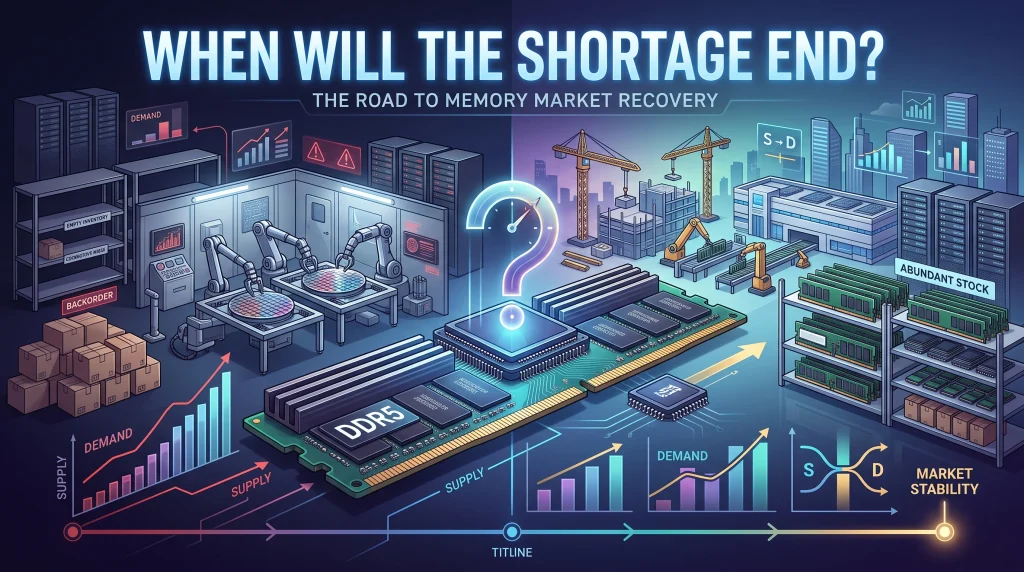
If you are holding out for a quick market correction, you will need to be patient. Foundries are currently operating at maximum capacity. While Samsung, SK Hynix, and Micron are all investing heavily—to the tune of tens of billions of dollars—in new fabrication plants and advanced packaging lines across the US, Europe, and Asia, semiconductor facilities are notoriously slow to build.
These “megafabs” take years to construct, tool with extremely sensitive extreme ultraviolet (EUV) lithography machines, and bring online with acceptable yields. Industry analysts, and my own observations of hardware cycles, suggest we will not see any significant market relief or supply normalization until late 2027 or early 2028.
Until that new factory capacity comes online, we are stuck in a seller’s market. Every time you buy a stick of RAM, remember that you are indirectly outbidding massive tech conglomerates trying to build their next multi-billion-dollar AI supercomputer.
DRAM Supply Squeeze Simulator
Simulating how AI HBM wafer allocation cannibalizes DDR5 consumer supply due to the 3x die size penalty.