
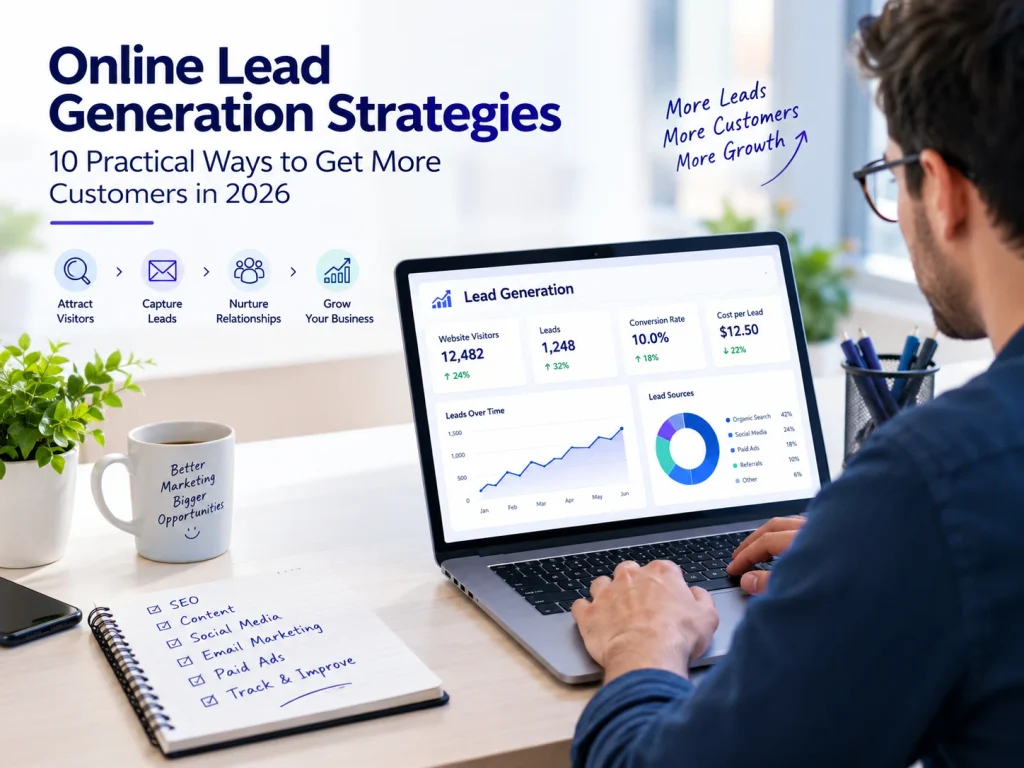
Learn 10 online lead generation strategies to attract qualified prospects, improve conversions, and grow your small business in 2026.
Online Lead Generation Strategies: 10 Practical Ways to Get More Customers in 2026
Getting website visitors is useful, but visitors alone do not grow a business. You need to turn the right visitors into potential customers, build trust with them, and guide them toward a purchase.
That is where online lead generation strategies come in. Whether you run a small business, freelance service, online store, or B2B company, a clear lead generation process can help you attract interested prospects without wasting your marketing budget.
You do not need to use every marketing channel at once. Start by understanding your audience, create a valuable offer, and choose the channels that match how your customers search for solutions.
In this guide, you will learn 10 practical online lead generation strategies, how to implement them, which metrics to track, and how to build a simple system that you can improve over time.
Quick Answer: What Are the Best Online Lead Generation Strategies?
The best online lead generation strategies help businesses attract relevant visitors and encourage them to take a meaningful action, such as requesting a quote, booking a consultation, signing up for a newsletter, or starting a free trial.
Here are 10 strategies to consider:
- Optimize your website for search engines.
- Publish helpful content that solves customer problems.
- Create a dedicated landing page.
- Offer a valuable free resource.
- Use email marketing to nurture prospects.
- Share useful content on social media.
- Run targeted online advertising campaigns.
- Improve your calls to action and website forms.
- Use customer reviews and referrals.
- Track results and improve your campaigns.
The most important principle: Focus on qualified leads rather than collecting as many email addresses as possible. A smaller number of genuinely interested prospects can be more valuable than a large list of people who never become customers.
What Is Online Lead Generation?
Online lead generation is the process of attracting potential customers through digital channels and encouraging them to share their contact information or express interest in your product or service.
A lead might be someone who downloads your guide, requests a quote, books a product demonstration, or subscribes to your business newsletter.
For example, imagine you own a website design business. A visitor finds your article about website speed through Google. At the end of the article, you offer a free website performance checklist. The visitor downloads the checklist and voluntarily provides an email address.
That person becomes a lead because they have shown interest in a problem your business can help solve.
How Does the Lead Generation Process Work?
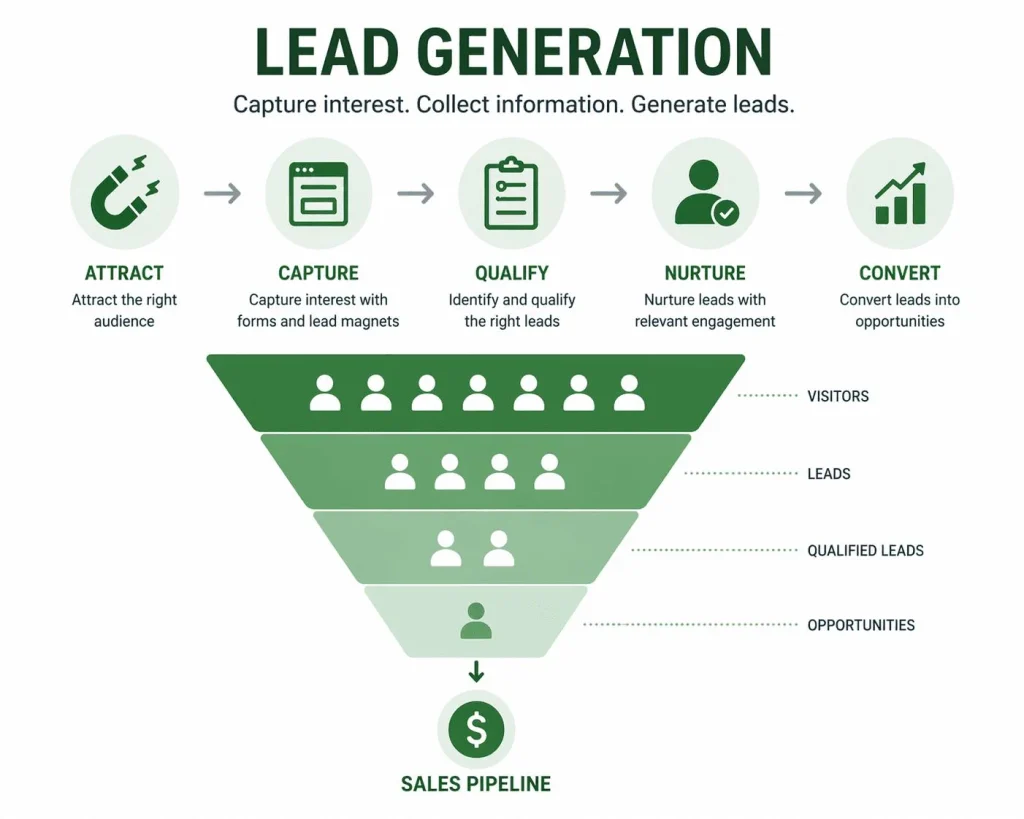
Most online lead generation systems follow five basic stages:
- Attract: Bring relevant people to your website through search, social media, advertising, or referrals.
- Engage: Give visitors useful information that addresses their needs.
- Capture: Encourage interested visitors to submit a form, subscribe, or request a consultation.
- Nurture: Build trust through helpful emails, relevant content, and timely follow-ups.
- Convert: Help qualified prospects make an informed purchasing decision.
A clear process makes it easier to identify where potential customers leave and what you can improve.
10 Online Lead Generation Strategies That Work
1. Optimize Your Website for Search Engines
Search engine optimization (SEO) helps your website appear when people search for information, products, or services related to your business.
Unlike advertising, organic search does not require you to pay for every click. However, SEO takes time, and rankings are never guaranteed.
Start with keywords that reflect what your target customers want to accomplish. For example, a web design agency might target phrases such as “small business website design,” “website redesign services,” or “affordable website developer.”
How to use SEO for lead generation
- Research relevant keywords and understand their search intent.
- Create useful pages that answer the questions behind those searches.
- Write descriptive page titles and meta descriptions.
- Add clear calls to action to relevant articles and service pages.
- Improve page speed, mobile usability, and navigation.
- Link related articles and service pages together naturally.
- Monitor search impressions, clicks, and meaningful conversions.
You can use Google Search Console to understand how people find your website through Google Search.
For more practical advice, read Zestwear’s guide to Google Search Console keyword research.
Practical tip: Do not focus only on high-volume keywords. Specific searches often reveal a clearer need. A person searching for “how to fix a slow WordPress website” may be looking for a solution that a relevant service provider can offer.
2. Publish Helpful Content That Solves Customer Problems
Content marketing attracts potential customers by answering their questions before they decide to buy.
You can publish blog posts, tutorials, comparison articles, checklists, case studies, and frequently asked questions. The best format depends on your audience and the problem you want to solve.
For example, a bookkeeping company could publish an article about preparing small-business tax records. A software company might create a comparison guide explaining how different tools handle a particular task.
Create content that attracts potential customers
- List the most common questions your customers ask.
- Group those questions by topic and search intent.
- Choose topics that connect naturally to your products or services.
- Explain the solution with clear steps and practical examples.
- Add a relevant next step, such as a downloadable checklist or consultation.
- Update articles when information changes.
Avoid writing articles solely to insert keywords. Every page should help readers make progress toward a real goal.
You can also connect your content strategy with zero-budget marketing ideas for small businesses to explore ways to promote useful content without relying entirely on paid campaigns.
Practical tip: A helpful article should not force every reader to buy something. Offer a relevant next step for people who need more help, and let informational content build trust over time.
3. Create a Dedicated Landing Page
A landing page gives visitors one clear offer and one primary action. It can promote a consultation, free trial, product demonstration, downloadable resource, or service package.
Sending every advertising or email visitor to your homepage can create unnecessary friction. A dedicated landing page keeps the message consistent from the original campaign to the final action.
Essential elements of a strong landing page
- Clear headline: Explain the main benefit.
- Short supporting copy: Describe the problem you solve.
- Relevant visuals: Show the product, service, or outcome where appropriate.
- Specific call to action: Tell visitors what to do next.
- Simple form: Request only the information you need.
- Trust signals: Include genuine testimonials, clear contact details, or relevant credentials.
- Mobile-friendly layout: Make the page easy to use on smaller screens.
For example, a headline such as “Get a Free Website Performance Review” explains the offer more clearly than a generic heading such as “Welcome to Our Company.”
Test one change at a time. You might compare two headlines or two button labels to learn which version generates more qualified inquiries.
4. Offer a Valuable Free Resource
A lead magnet is a useful resource that visitors can access in exchange for their contact details. It works best when it solves a specific problem for a clearly defined audience.
Common examples include:
- Downloadable checklists
- Templates and worksheets
- Beginner’s guides
- Industry reports
- Budget calculators
- Short email courses
- Free audits or assessments
Suppose you provide SEO services. You could offer a website SEO checklist that helps business owners identify common on-page issues. The resource attracts people who already care about improving their websites.
How to create a lead magnet
First, identify one problem your audience wants to solve. Then create a resource that helps them take the next step. Explain what they will receive, make the download process simple, and deliver the resource promptly.
Do not promise unrealistic outcomes. A checklist can help someone identify SEO issues, but it cannot guarantee first-page rankings.
You should also explain how you will use collected contact information and obtain appropriate consent for marketing communications.
Practical tip: A short, actionable resource can outperform a long, generic ebook when it addresses an immediate problem.
5. Use Email Marketing to Nurture Leads
Not every prospect is ready to purchase when they first visit your website. Email marketing helps you maintain contact and provide useful information while people consider their options.
You can build an email list through a newsletter, lead magnet, webinar, free trial, or consultation form.
Once someone subscribes, send messages that match their interests and the reason they signed up.
A simple lead-nurturing sequence
| Purpose | Example | |
|---|---|---|
| Welcome | Deliver the promised resource | Send the checklist or guide |
| Educational | Help solve a related problem | Share a useful tutorial |
| Trust-building | Answer common concerns | Explain your process or share a genuine case study |
| Offer | Suggest a relevant next step | Invite the subscriber to book a consultation |
You do not need to send an email every day. Focus on relevance, consistency, and usefulness.
Segment subscribers when possible. Someone who downloads a beginner’s guide may need different information from someone who requests a pricing estimate.
Always respect unsubscribe requests and applicable privacy and email marketing laws.
6. Share Useful Content on Social Media
Social media can help your business reach potential customers, demonstrate expertise, and bring interested people to relevant pages on your website.
Choose platforms based on where your audience spends time. A B2B consulting firm might prioritize LinkedIn, while a visual product brand may benefit more from Instagram or Pinterest.
Do not publish the same promotional message repeatedly. Mix educational posts with product demonstrations, short tutorials, customer questions, and relevant industry insights.
Social media lead generation ideas
- Share a short tip that links to a detailed article.
- Publish a step-by-step video that solves one problem.
- Answer common questions in posts or discussions.
- Offer a relevant downloadable resource.
- Direct interested users to a dedicated landing page.
- Use a clear call to action when a post has a specific goal.
Track website visits, inquiries, qualified leads, and sales from each platform. Likes and followers can provide useful context, but they do not necessarily indicate business results.
Practical tip: Make each post useful on its own. When readers receive value before clicking, they have a stronger reason to trust the content behind the link.
7. Run Targeted Online Advertising Campaigns
Paid advertising can help you reach potential customers faster than waiting for organic traffic to grow. However, it requires a budget, careful targeting, and ongoing measurement.
Common options include search advertising, social media advertising, and retargeting where permitted and appropriately configured.
Search ads can reach people who actively look for a solution. Social ads can introduce an offer to a relevant audience. Retargeting can reconnect with eligible previous visitors, subject to consent, platform rules, and applicable privacy requirements.
How to start with a limited budget
- Choose one specific business goal.
- Define the audience you want to reach.
- Select one advertising channel.
- Create a focused landing page.
- Set a budget you can afford to test.
- Measure qualified leads and sales, not just clicks.
- Pause weak campaigns and test improvements carefully.
For example, a local service business could test a search campaign targeting people looking for a particular service in its coverage area.
Do not assume that a low cost per lead automatically means a successful campaign. If the leads never respond or purchase, the campaign may not deliver meaningful value.
8. Improve Your Calls to Action and Website Forms
A call to action (CTA) tells visitors what step to take next. A form collects the information needed to respond to their interest.
Even useful content can generate few leads if visitors cannot easily find the next step.
Replace vague button labels with specific wording. Depending on the offer, you might use “Download the Free Checklist,” “Request a Quote,” or “Book a Consultation.”
Make your forms easier to complete
- Ask only for information you genuinely need.
- Use clear field labels.
- Explain what happens after submission.
- Make forms easy to complete on mobile devices.
- Display helpful error messages.
- Confirm successful submissions.
- Test the form regularly.
A short form may attract more submissions, while a longer form can help qualify prospects. The right balance depends on your offer and sales process.
For example, a newsletter form may need only an email address. A quote request may reasonably ask about the service required, project scope, and preferred contact method.
Practical tip: Test your entire lead journey yourself. Visit the page, submit the form, check the confirmation message, and verify that the inquiry reaches the correct inbox or customer management system.
9. Build Trust With Customer Reviews and Referrals
People often look for evidence that a business can deliver what it promises. Genuine customer feedback, useful case studies, and recommendations can help reduce uncertainty.
Ask satisfied customers to share honest feedback. Explain your service process clearly, display accurate business information, and respond professionally to reasonable concerns.
You can also create a referral process that makes it easy for existing customers to recommend your business.
Ways to encourage referrals
- Ask satisfied customers if they know someone who needs your service.
- Provide a simple referral link or introduction process.
- Thank customers for genuine recommendations.
- Explain any referral incentives clearly.
- Follow up promptly when a referred prospect contacts you.
Never buy fake reviews or invent customer results. Misleading testimonials can damage trust and may violate platform policies or local laws.
Practical tip: A specific, genuine case study often provides more useful evidence than a vague claim such as “We are the best company.”
10. Track Results and Improve Your Lead Generation Funnel

Successful lead generation depends on learning what attracts the right people and what helps them become customers.
Without measurement, you may spend time on channels that generate traffic but few meaningful inquiries.
Start with a small set of metrics:
| Metric | What it tells you |
|---|---|
| Website traffic | How many visitors reach your pages |
| Lead conversion rate | What share of visitors become leads |
| Cost per lead | How much you spend to acquire a lead |
| Lead quality | How closely leads match your target customers |
| Lead-to-customer rate | What share of leads become paying customers |
| Revenue by channel | Which sources contribute to sales |
For a simple lead conversion rate, divide the number of leads by the number of relevant visitors and multiply by 100.
Example: If a landing page receives 500 visitors and generates 25 leads, its lead conversion rate is 5%.
This example illustrates the calculation, not an industry benchmark.
How to track lead generation performance
Use Google Analytics to understand how visitors interact with your website. Configure meaningful events for actions such as submitting a lead form or booking a consultation, and mark the relevant events as key events when appropriate. Google’s official guide to key events explains how to measure important user actions.
You can also use a customer relationship management (CRM) system or a simple spreadsheet to track lead sources, follow-up dates, status, and outcomes.
Review results regularly. If a page attracts visitors but few people submit the form, improve the offer, message, page experience, or form. If a channel produces many leads but few sales, review lead quality and follow-up practices.
For additional improvements, read our guide on how to make a website load faster. A faster, easier-to-use website can reduce friction during the lead generation process, although speed alone does not guarantee more leads.
How to Choose the Right Lead Generation Strategy
You do not need to implement all 10 strategies at the same time. Select a starting point based on your business model, resources, and how quickly you need results.
| Business type | Good starting strategies | Main focus |
|---|---|---|
| Local service business | Local search, reviews, landing pages | Calls and quote requests |
| B2B company | SEO, useful content, email nurturing | Qualified business inquiries |
| Freelancer | Portfolio, social content, referrals | Consultation requests |
| Online store | SEO, email signup, product pages | Product interest and purchases |
| New small business | Helpful content, referrals, simple landing page | Learning which offer attracts customers |
These are starting points, not strict rules. Your best channel will depend on customer behavior, competition, offer quality, and your ability to follow up.
A Simple 30-Day Online Lead Generation Plan
If you are starting from scratch, use the following plan to build a manageable system.
Week 1: Understand Your Audience
- Describe your ideal customer.
- Identify their main problems and buying concerns.
- Review the questions they ask before purchasing.
- Choose one product, service, or offer to promote.
- Set a clear lead generation goal.
Week 2: Build Your Lead Capture System
- Create or improve one relevant landing page.
- Write a clear headline and supporting copy.
- Add a simple form and specific call to action.
- Create a useful free resource if it fits your offer.
- Test the page and form on desktop and mobile.
Week 3: Attract Relevant Visitors
- Publish one helpful article or improve an existing one.
- Share useful content on one suitable social platform.
- Connect relevant articles and service pages with internal links.
- Consider a small paid campaign only if your budget allows.
- Make sure visitors can find the offer easily.
Week 4: Measure and Improve
- Count leads by source.
- Review the quality of the inquiries.
- Check whether visitors complete the form.
- Follow up with leads promptly and appropriately.
- Improve the weakest part of the process.
At the end of 30 days, identify what worked and what needs more testing. Some channels, especially SEO, may require more time before they produce meaningful results.
Common Online Lead Generation Mistakes to Avoid
Even a good strategy can underperform when a business overlooks basic details.
Focusing on traffic instead of leads: More visitors do not automatically mean more customers. Track meaningful actions alongside traffic.
Using a vague offer: Explain exactly what visitors will receive and why it helps them.
Making forms too complicated: Collect only the information you need at that stage of the customer journey.
Ignoring follow-up: A useful inquiry can lose value if nobody responds. Assign responsibility and set a reasonable response process.
Using every channel at once: Start with a small number of channels and learn which ones attract qualified prospects.
Failing to measure outcomes: Track lead quality and sales, not just impressions, likes, or email signups.
Making unrealistic promises: Use accurate claims, genuine testimonials, and transparent offers to build long-term trust.
Frequently Asked Questions
What is the best online lead generation strategy?
The best strategy depends on your audience, budget, and business model. SEO and helpful content can attract people who are actively researching solutions. Landing pages and forms help capture interest, while email marketing and follow-up help nurture prospects.
How can I generate leads online for free?
You can start with organic SEO, helpful blog content, relevant social media posts, customer referrals, and a simple landing page. These approaches require time and effort, even when they do not involve direct advertising costs.
How long does online lead generation take?
The timeline varies by channel and business. Paid advertising can generate inquiries quickly when the campaign and offer work well. SEO and content marketing often take longer because visibility and trust develop over time. Neither approach guarantees results.
Which tools can help with online lead generation?
Useful tool categories include website analytics, keyword research, email marketing, landing page builders, form tools, and CRM software. Choose tools based on your actual needs, budget, privacy requirements, and ability to use the data they collect.
How do I measure lead generation success?
Track the number of leads, lead conversion rate, cost per lead where applicable, lead quality, lead-to-customer rate, and revenue by channel. These metrics help you understand whether your campaigns contribute to business goals.
Is online lead generation suitable for small businesses?
Yes. Small businesses can start with a focused offer, helpful content, referrals, and a simple lead capture page. They can then expand into additional channels after they learn which methods attract qualified prospects.
Final Thoughts
Effective online lead generation is not about collecting the largest possible number of contacts. It is about attracting the right audience, offering genuine value, making the next step easy, and following up in a helpful and timely way.
Start with one or two strategies that fit your business. Improve your website, publish useful content, create a clear offer, and track what happens after visitors arrive. Use those results to decide where to invest your time and budget next.
With a consistent process and regular improvements, you can build a more reliable way to attract potential customers and support long-term business growth.