
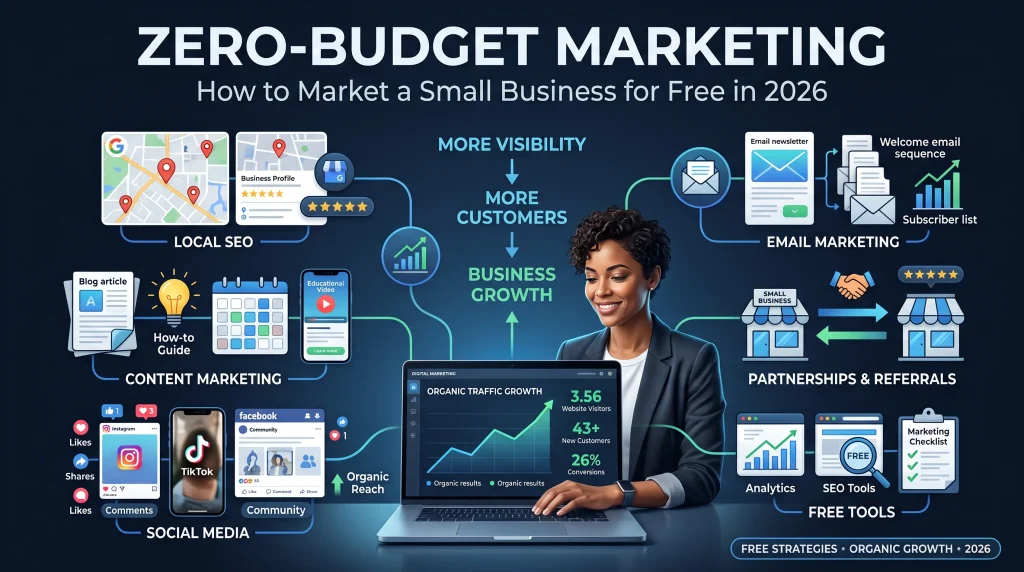
Discover how to market a small business with no budget in 2026. Scale for free using local SEO, email sequences, and zero-cost business partnerships.
Zero-Budget Marketing: How to Market a Small Business for Free in 2026
For many entrepreneurs in 2026, navigating the digital landscape can feel overwhelming, especially when competing against established brands with massive advertising budgets. However, an effective marketing strategy for a small business does not require a massive budget or a dedicated marketing department; rather, it requires clarity and consistency.
If you are trying to figure out how to market a small business with no budget, you must shift your mindset from outbound, interruptive advertising to inbound marketing, where customers find you naturally through helpful content and organic channels. By trading financial capital for creativity, relationship-building, and high-value content, you can build a sustainable, long-term growth engine.
Here is a comprehensive guide detailing the best zero-budget small business marketing ideas to scale your business for free in 2026.
1. Lay the Foundation: Buyer Personas and Free Websites
Before you execute any marketing tactics, you must establish a solid foundation. If you jump straight into tactics—like posting on TikTok just because it is trending—without defining your underlying strategy, you are building on sand.
Define Your Core Audience
You cannot market to “everyone”; if you sell to everyone, you appeal to no one. To succeed with zero budget, you must build detailed buyer personas to understand your customer. You need to ask yourself specific questions about your audience:
- What is the primary problem our product or service solves for them?
- Where do they actively look for information to solve this problem?
- What are their top three objections or concerns when choosing a provider?
Build a Free Website
If you lack the budget to hire a professional website developer, you can still establish an online presence. You can build your website using free plans from several companies that require no coding skills:
- Wix Free Plan: Offers a drag-and-drop builder with customizable templates, though the URL will include Wix branding.
- WordPress.com Free Plan: This is ideal for blogs and small websites, offering basic templates and plugins.
- Weebly Free Plan: This option is beginner-friendly and includes eCommerce options, with Weebly branding in the URL.
2. Master Local SEO and Your Google Business Profile
For local businesses, a Google Business Profile (GBP) has become one of the most effective free marketing strategies available. Optimizing for local search is critical because 46% of Google searches have local intent. To maximize your visibility without a budget, you must align your profile with Google’s official guidelines on local ranking which state that local search success relies entirely on relevance, distance, and prominence
Optimize Your Profile
Creating and verifying your Google Business Profile is completely free. To maximize its impact, you must fill out your categories and service descriptions completely. Ensure you add your logo, correct phone number, website URL, service area, and high-quality photos and videos.
Manage Customer Reviews
Customer reviews are a vital component of local SEO. Nearly 95% of consumers read online reviews before making a purchase. You should actively request reviews by asking satisfied customers to leave feedback on platforms like Google, Facebook, and Yelp. Furthermore, you must respond to every review—both positive and negative—within 24 to 48 hours to demonstrate that you value your customers.
Implement On-Page Local SEO
To further boost your organic traffic, you can do some local SEO on your own website. Instead of paying for expensive software, you can use 100% free SEO tools to analyze your local competitors, find high-volume search terms, and naturally integrate location-based keywords (like ‘Portland bakery’) into your page headings and titles
- Use a keyword research tool like Google Keyword Planner to find out what your customers are searching for.
- Add location-based keywords (for example, “Portland bakery”) to the headings, titles, and body content of your website pages.
- Publish blog posts or pages that are specific to the neighborhoods you serve.
- Ensure your business information is identical across online directories.
3. Shift to Problem-Solving Content Marketing
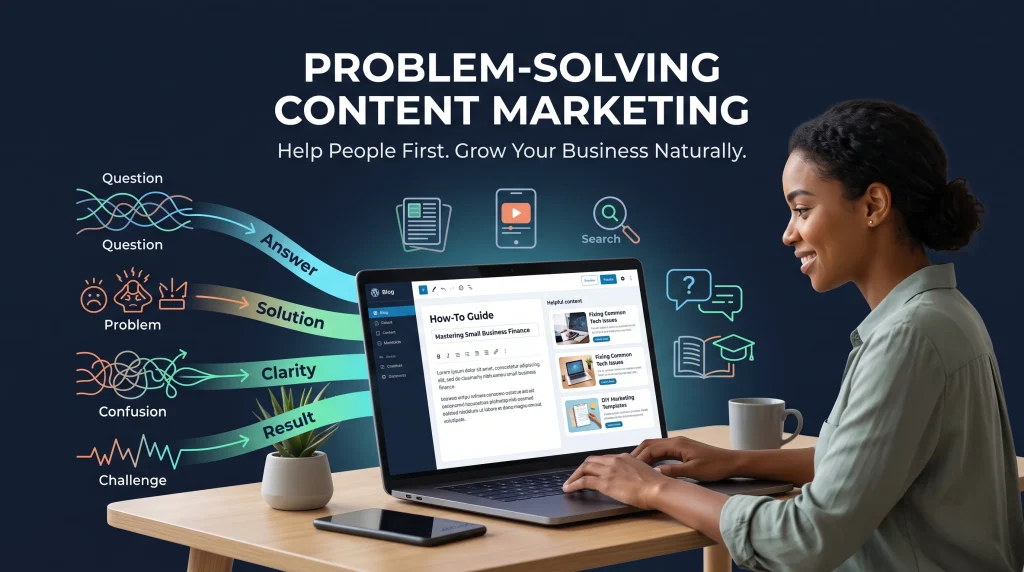
Content marketing answers buyer questions and builds authority over time. The core idea is to create and distribute valuable content that addresses your target audience’s pain points, positioning your brand as a trusted authority.
Start a Blog
Small businesses use blogging to increase user engagement, drive traffic to their website, strengthen overall SEO, and improve online visibility. A coffee shop, for instance, could create a blog post on “How to Brew the Perfect Pour-Over at Home,” which naturally draws in an audience.
Create “How-To” Video Content
Video content can be highly engaging and produced with minimal resources using just your phone. Creating a 60-second instructional video builds authority swiftly.
- If you are a plumber, you can share a video on “How to unclog a drain”.
- If you own a restaurant, you might share a video demonstrating “5 Simple Plating Techniques to Impress Your Guests”.
- You can also create videos with AI to help transform your expertise into captivating content.
When using AI tools for content, use them primarily for drafting, researching, and outlining, and always inject your own real-world expertise and unique brand voice.
4. Hyper-Focus Your Social Media Strategy
Social media marketing can be completely free and is a top channel for business growth. However, attempting to post on Facebook, Instagram, LinkedIn, TikTok, and Pinterest all at once will quickly burn out your resources and result in low-quality content.
Choose One Platform First
Do not try to be everywhere; pick one platform (like Instagram or Reddit) and build consistency there before expanding. You should choose one or two platforms where your target customers are most active and commit to posting high-quality content consistently.
Provide Value Over Promotion
To stand out on noisy social media platforms, you need to stop selling and start educating or entertaining. Post value-driven content like insights and tips instead of only promoting. People do not like being sold to directly, so use a soft promotion approach where you provide value first, and then mention your product or service in a helpful way.
Embrace Authenticity and UGC
Authenticity is a huge trend for 2026; consumers want to buy from humans rather than faceless corporations.
- Go Behind the Scenes: Show the team meetings, the packaging process, or the “mess” of running your business. This builds transparency.
- Employee Spotlights: Post a bio and photo of a team member to humanize your brand.
- User-Generated Content (UGC): Encourage your customers to tag you in photos of your product. Reposting their content acts as powerful social proof, effectively turning customers into your marketing team. You can even run a “Photo of the Month” contest to encourage this.
5. Own Your Audience with Email Marketing
Email marketing is your only truly owned channel, delivering an impressive $36 for every $1 spent. It remains a cost-effective strategy to maintain customer relationships and nurture leads.
Build Your List Immediately
An email list is a direct line to your most engaged audience. To capture subscribers, offer a “Lead Magnet” to lower the barrier to entry. For example, a consultant might offer a free 15-minute audit, while a cleaner could offer a “one-room trial” at a discount. You can also offer a bonus content piece to get new website visitors to sign up for your newsletter.
Automate a Welcome Sequence
You can use tools like HubSpot (which offers a free CRM and email marketing tool) or MailChimp to start your campaigns. Once someone subscribes, send a series of 3 to 5 automated emails introducing your brand and offering core services. A proven 3-email sequence includes:
- Email 1: A welcome message plus a discount code.
- Email 2: Your brand story, explaining why you started the business.
- Email 3: Social proof, such as case studies or reviews.
After the welcome sequence, maintain a consistent schedule by sending 1 to 4 helpful, non-sales-heavy emails each month to encourage repeat purchases and keep your business top-of-mind.
6. Leverage Strategic Partnerships and Referrals
Partnerships and referrals are often the most trusted and underused growth channels. Building relationships with industry peers opens doors to new opportunities.
Cross-Promotions
Partner with complementary, non-competing businesses to promote each other’s services. Find a business that shares your audience but not your service. For example, a gym could partner with a health food store; the gym provides a coupon for the store to its new members, and the store places the gym’s flyers in every customer’s bag.
Customer Referral Programs
Research shows customers are more likely to buy a service if they learn about it from strangers, making friend and family referrals incredibly valuable. Word-of-mouth is one of the best marketing strategies to boost sales. Set up a customer referral program to incentivize your current happy customers to sell for you. Offer them a free product or discount for referring new business. A simple, proven structure is the “Give $20, Get $20” model.
7. Embrace Grassroots and Guerrilla Marketing
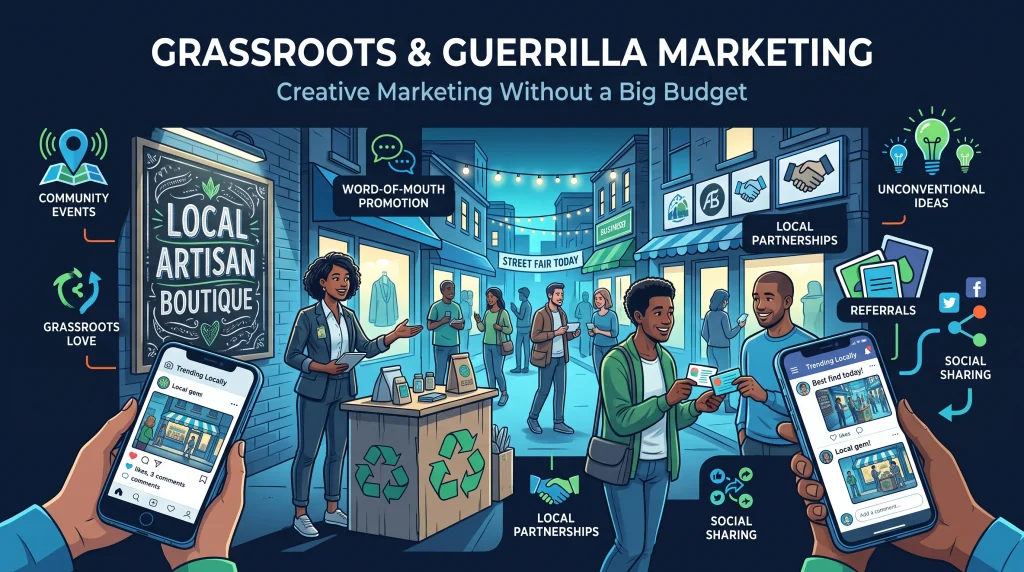
In the early stages, your first 100 customers usually come from “hand-to-hand combat” rather than passive ads. You have to do things that do not scale, such as sending direct messages to potential clients, attending local networking events, and asking family and friends for referrals.
Host Events and Workshops
Hosting classes and events is a practically free marketing idea. Host free workshops to showcase your expertise. If you are a financial advisor, you could host a “Retirement Planning 101” seminar at the local library, or if you sell flowers, host a flower-arranging night.
If reaching people in person does not appeal to you, run informative webinars. Webinars are a free way to provide helpful information to potential customers, and you can broadcast them using platforms like GoToMeeting or Webex.
Creative Guerrilla Tactics
Guerrilla marketing relies on high creativity and low cost, doing the unexpected to get attention.
- Sticker Marketing: Create high-quality, cool art stickers (not just your logo) and give them away. People will put them on water bottles and laptops, turning them into walking billboards.
- Podcast Guesting: You do not need to start your own podcast; instead, be a guest on existing podcasts that your audience listens to. It establishes you as a thought leader and provides free exposure.
- Community Sponsorships: Sponsoring a local 5K or putting your name on a Little League jersey builds immense goodwill in your community.
Conclusion: Monitor and Refine
Finally, utilizing free online tools is essential to measure your success. You can use Google Analytics to track your website traffic and gain insights into visitor behavior. By utilizing analytics to refine your approach, you ensure your zero-budget marketing efforts yield the best possible results.
Marketing a small business for free is entirely possible in 2026. By focusing on organic local SEO, creating problem-solving content, building an owned email list, and relying on grassroots community partnerships, you can create a highly scalable marketing ecosystem without spending a dime on traditional advertising.