
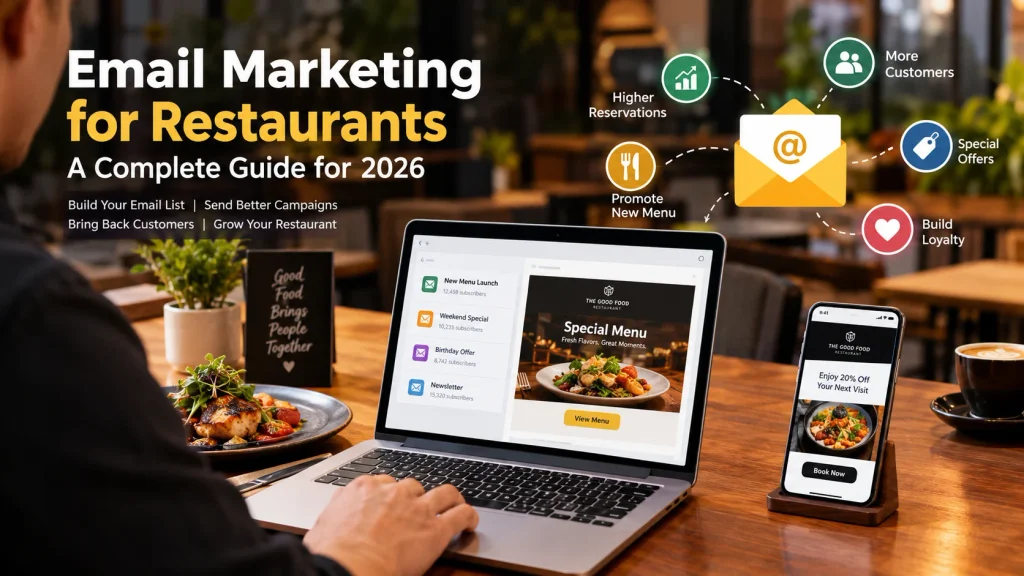
Learn email marketing for restaurants, including list building, promotional campaigns, free tools, best practices, and ways to encourage repeat visits.
Email Marketing for Restaurants: A Complete Guide for 2026
Email marketing for restaurants is a practical way to stay connected with customers, promote special offers, announce new menu items, and encourage repeat visits. Whether you run a small café, a family restaurant, or a food delivery business, email can help you communicate directly with people who want to hear from you.
Unlike social media posts, which depend partly on platform algorithms, emails go directly to subscribers’ inboxes. However, results depend on the quality of your email list, the relevance of your offers, and how well you manage your campaigns.
In this guide, you will learn how email marketing for restaurants works, how to build an email list, which campaigns to send, which tools to consider, and how to measure results.
What Is Email Marketing for Restaurants?
Email marketing for restaurants is the process of sending relevant emails to customers and subscribers to promote a restaurant, share updates, build customer loyalty, and encourage reservations or orders.
For example, a local restaurant might send an email announcing a new lunch menu, a weekend special, a seasonal offer, or an upcoming event. A café might send a welcome email to new subscribers or a birthday offer to customers who have chosen to receive such messages.
Restaurant email marketing can include two broad types of messages:
- Promotional emails: Special offers, new menu announcements, newsletters, events, and loyalty rewards.
- Transactional emails: Reservation confirmations, order receipts, and important booking updates.
These messages serve different purposes. Promotional emails encourage customers to take action, while transactional emails provide information about a service they have already requested.
Why Is Email Marketing Important for Restaurants?
Restaurants operate in a competitive market. Customers have many choices, and a single visit does not guarantee that they will return. Email marketing provides a way to maintain a relationship after customers leave the restaurant.
1. Bring Back Repeat Customers
Existing customers already know your restaurant and may be more willing to visit again when they receive a relevant offer or update.
For example, a restaurant can send a weekend menu announcement to subscribers who previously showed interest in its dining offers. The goal is to give customers a useful reason to return without overwhelming them with messages.
2. Promote Special Offers and Discounts
Email is useful for communicating limited-time promotions, weekday deals, seasonal menus, and special dining packages.
A restaurant might promote a lunch offer during quieter hours or announce a family meal package before a holiday. Each campaign should have clear terms, including the offer’s validity and any restrictions.
3. Encourage Reservations and Direct Orders
A well-designed email can link directly to your reservation page, online menu, or ordering system.
For example, an email announcing a new dinner menu could include a button saying “Reserve Your Table.” A takeaway restaurant might use “Order Online” instead.
Make sure the destination page works properly on mobile devices and clearly explains the next step.
4. Build Strong Customer Relationships
Emails do not always need to contain discounts. Restaurants can share chef introductions, stories about ingredients, behind-the-scenes updates, or information about upcoming events.
Useful and interesting content helps customers understand what makes a restaurant different from its competitors.
5. Promote New Menu Items
When a restaurant introduces a new dish, seasonal drink, or special menu, email provides a direct way to announce it to interested subscribers.
Use an appealing, accurate photograph, a short description, and a clear call to action. Avoid making unsupported claims about ingredients, health benefits, or product availability.
How to Build an Email List for Your Restaurant
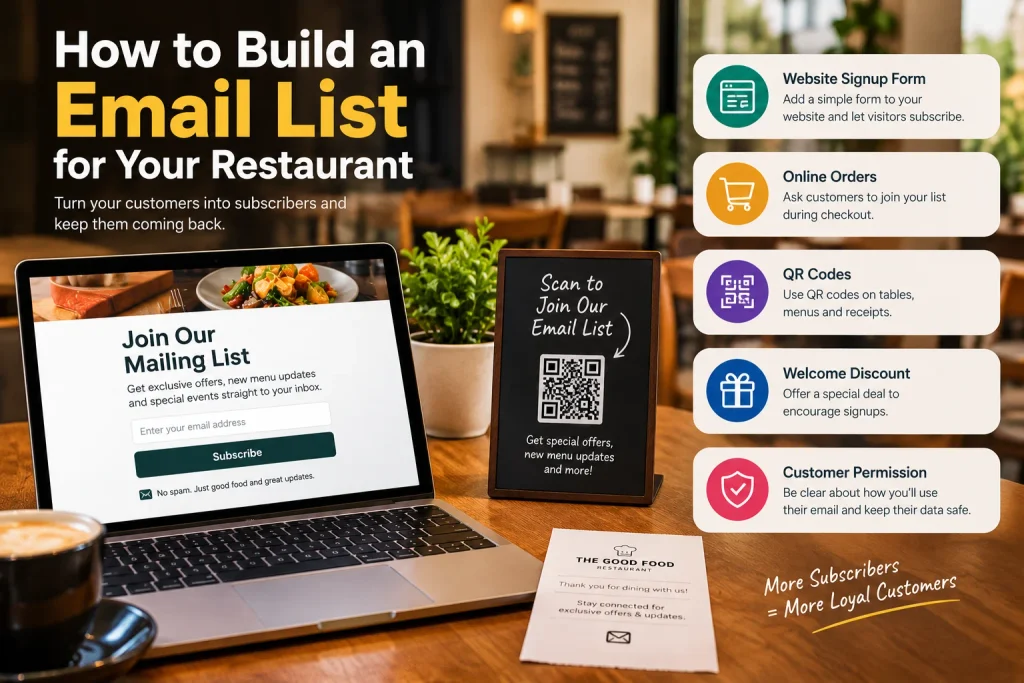
A quality email list is more useful than a large list of people who never agreed to receive marketing messages. Focus on collecting addresses from customers who genuinely want restaurant updates.
1. Add a Signup Form to Your Website
Place a simple email signup form on your restaurant’s website. Explain what subscribers can expect, such as monthly menu updates, occasional offers, or event announcements.
Keep the form short. An email address may be enough to get started; ask for additional details only when they are useful.
2. Invite Online Customers to Subscribe
If your restaurant accepts online orders or reservations, offer customers a separate, clear option to subscribe to promotional emails.
Do not assume that someone who placed an order automatically agreed to marketing messages. Keep the consent request clear and separate where appropriate.
3. Use QR Codes on Tables and Receipts
A QR code can direct diners to a signup page. You might display it on a table card, printed receipt, takeaway packaging, or menu.
Explain the benefit of subscribing before asking customers to scan it. For example, they might receive occasional menu updates or information about upcoming events.
4. Offer a Welcome Discount
A welcome offer can encourage customers to subscribe. Depending on your budget, you might offer a small discount, a complimentary side dish with a qualifying order, or early access to a new menu.
Make the terms easy to understand, and ensure that the offer is financially sustainable for your restaurant.
5. Respect Customer Permission and Privacy
Collect email addresses transparently and explain how they will be used. Keep customer information secure, provide a working unsubscribe option, and follow applicable privacy and email marketing laws.
Never purchase random email lists or add customers to promotional campaigns without an appropriate legal basis and permission where required.
Best Types of Restaurant Marketing Emails
Different emails serve different purposes. A balanced campaign should provide value instead of sending the same discount to every subscriber.
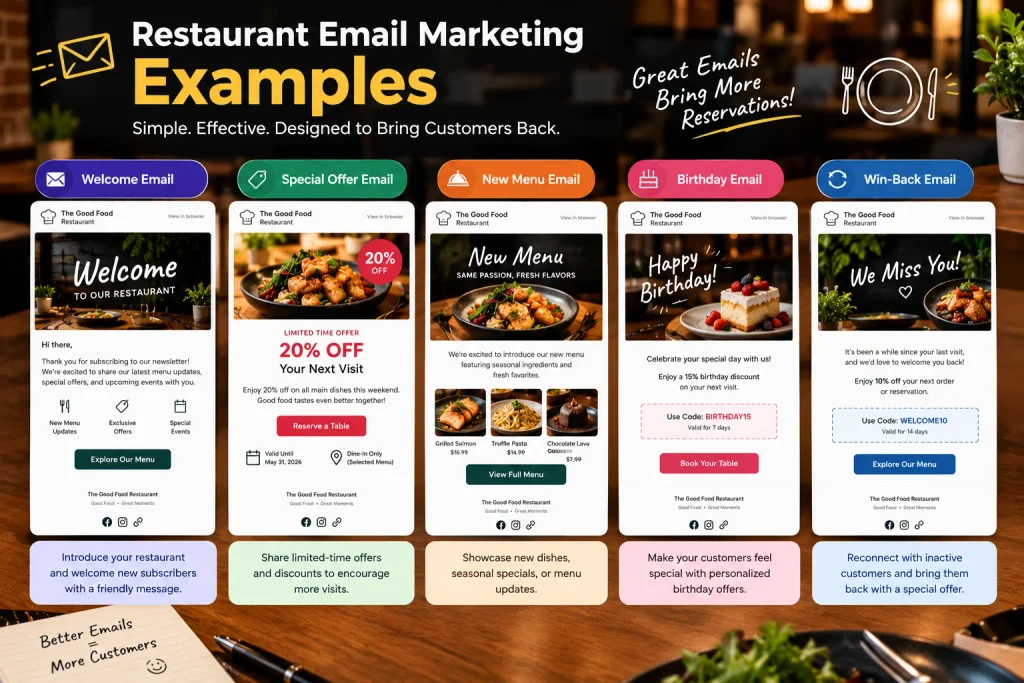
1. Welcome Emails
A welcome email is sent after someone subscribes. It can introduce the restaurant, explain what subscribers will receive, and share a menu or booking link.
Example subject line: Welcome to [Restaurant Name]!
Example message:
“Thanks for joining our community! We look forward to sharing our latest dishes, seasonal menus, and restaurant updates with you. Explore our menu and plan your next visit.”
2. Newsletters
A restaurant newsletter can include new dishes, chef stories, upcoming events, seasonal ingredients, and occasional offers.
Small restaurants can start with a monthly newsletter rather than trying to send an email every day. The right frequency depends on how much useful news the business has to share and how subscribers respond.
3. Special Offers and Discount Emails
These emails announce promotions such as weekday lunch deals, family packages, or limited-time menu offers.
Example subject line: Your Weekend Dining Plan Starts Here
Include the offer, expiry date, important conditions, and a direct link to make a reservation or order.
4. Birthday and Anniversary Emails
If customers voluntarily provide the relevant information and agree to receive these messages, a restaurant can send a birthday offer or anniversary greeting.
Keep the message personal but respectful. Avoid collecting unnecessary personal information, and clearly state how the offer can be redeemed.
5. New Menu Announcement Emails
Use these emails to introduce new dishes, seasonal drinks, chef’s specials, or updated menus.
A useful structure includes a short introduction, one or two featured items, an accurate image, and a button leading to the full menu.
6. Win-Back Emails for Inactive Customers
A win-back email is designed to reconnect with subscribers who have not recently engaged or customers who have not returned for some time, where you have an appropriate basis to contact them.
Keep the message friendly and relevant. One well-timed reminder may be more effective than repeatedly sending discounts to people who no longer want to hear from you.
How to Create an Effective Restaurant Marketing Email
An effective email should be easy to read, visually appealing, and focused on one main action.
Write a Clear Subject Line
The subject line should tell readers what the email contains. Avoid misleading claims or exaggerated promises.
Examples include:
- Discover Our New Seasonal Menu
- This Weekend’s Specials at [Restaurant Name]
- Join Us for Our Upcoming Food Event
- Your Birthday Treat from [Restaurant Name]
Use High-Quality Food Images
Food photography can help readers understand what is being offered. Use clear, relevant images that accurately represent the restaurant’s dishes.
Compress images so they load quickly, and include descriptive alternative text where appropriate. Do not rely entirely on images to communicate important information because some email clients block images by default.
Keep the Message Short and Useful
Start with the most important information. Explain the offer or update, include any necessary terms, and guide readers toward one clear action.
Avoid adding multiple unrelated promotions to the same email.
Add a Clear Call to Action
A call to action (CTA) tells the reader what to do next.
Examples include:
- View Our Menu
- Reserve a Table
- Order Online
- Explore the New Dishes
- See Upcoming Events
Use a link that leads directly to the relevant page instead of sending every reader to the homepage.
Make Emails Mobile-Friendly
Many customers read emails on their phones. Use readable text, simple layouts, appropriately sized buttons, and images that adapt to smaller screens.
Before sending a campaign, preview it on mobile and desktop, test the links, and send a test email to yourself. Email testing and authentication are among the best practices recommended by email marketing providers.
Restaurant Email Marketing Examples
The following examples show how a restaurant can use email marketing in practical situations. Replace the sample details with your actual menu, prices, dates, and offers.
Example 1: New Menu Launch
Subject: Discover Our New Menu at [Restaurant Name]
“Hello [First Name],
We have added new dishes to our menu and would love for you to try them. Explore the latest additions, discover your next favourite meal, and plan your next visit.
View our updated menu and find your next dining experience.
[Explore the New Menu]”
Example 2: Weekend Special
Subject: Make Your Weekend Delicious
“Looking for a place to enjoy the weekend? Explore this week’s specials at [Restaurant Name].
Check the menu, review the offer details, and reserve your table before your preferred time fills up.
[View Weekend Specials]”
Example 3: Win-Back Email
Subject: We’d Love to Welcome You Back
“Hello [First Name],
It has been a while since your last visit, and we would love to welcome you back to [Restaurant Name].
Take a look at our latest menu and see what is new. We hope to serve you again soon.
[Explore Our Menu]”
Example 4: Birthday Offer
Subject: A Birthday Treat from [Restaurant Name]
“Happy Birthday, [First Name]!
We hope your day is full of wonderful moments and great food. To celebrate, enjoy the birthday offer described below.
Offer: [Insert Actual Offer and Conditions]
Valid until: [Insert Date]
[View Offer Details]”
Only send birthday emails when the customer has provided the relevant information and your use of it complies with your stated privacy practices.
Best Free and Affordable Email Marketing Tools for Restaurants
Email marketing software can help restaurants create campaigns, manage subscribers, schedule emails, and review performance. Compare current plan limits before choosing a platform, because free features and prices can change.
1. Mailchimp
Mailchimp provides email campaign creation, templates, audience management, and restaurant-specific marketing resources. It may suit restaurants that want to create newsletters and promotional campaigns using a familiar marketing platform.
2. Brevo
Brevo offers email campaigns, contact management, and additional communication tools. Its official pricing information lists a free plan with a limit of 300 email sends per day, although features and limits can change.
This may be a useful starting point for a small restaurant testing email marketing on a limited budget.
3. MailerLite
MailerLite is another option to consider for newsletters, signup forms, landing pages, and email automation. Check its current pricing and feature limits to determine whether the plan fits your restaurant’s needs.
4. HubSpot
HubSpot offers marketing tools alongside customer relationship management features. It may be worth considering if your restaurant wants to manage customer information and marketing activities in one system.
Check the current plan details before committing, especially if you need advanced automation or higher email volumes.
Which tool should you choose? A small restaurant can begin by comparing signup forms, campaign templates, automation, reporting, and sending limits. Start with the simplest plan that meets your needs, then upgrade only when the business requires additional features.
Restaurant Email Marketing Best Practices
Send Emails to Interested Subscribers
Build your list through transparent signup forms and respect customer preferences. Avoid sending unwanted promotions to people who have not agreed to receive them.
Segment Your Audience
Segmentation means dividing your subscribers into relevant groups. Depending on the information customers have agreed to share, you might separate subscribers by preferred location, dining interests, or engagement with previous campaigns.
Send each group information that is genuinely relevant to them.
Choose a Reasonable Sending Frequency
Sending too many emails can cause people to ignore your messages or unsubscribe. Start with a manageable schedule and adjust it based on engagement, feedback, and the amount of useful content you have.
Personalize Where It Adds Value
Using a customer’s name or sending a relevant menu update can make an email feel more personal. Personalization should be accurate and should not require collecting unnecessary data.
Authenticate Your Email Domain
If you send campaigns from your own domain, configure the appropriate email authentication records, such as SPF and DKIM, and follow your provider’s guidance on DMARC. Proper authentication helps email providers verify that your messages are legitimate.
Google’s sender guidance explains that bulk senders have additional authentication and unsubscribe requirements. Promotional email requirements can depend on sending volume and the applicable rules.
Official reference: https://support.google.com/mail/answer/14229414
Include an Unsubscribe Option
Give subscribers a clear way to stop receiving marketing emails and honour their requests promptly. Make sure your email platform and campaign setup comply with applicable requirements.
Test Every Campaign Before Sending
Check spelling, dates, offer terms, images, links, mobile layout, and the sender details. A broken booking link or incorrect offer can damage customer trust.
Common Restaurant Email Marketing Mistakes
Sending Too Many Emails
Frequent promotions can make subscribers lose interest. Focus on useful updates rather than sending emails simply to maintain a schedule.
Using Weak or Misleading Subject Lines
A subject line should accurately describe the email. Misleading language may lead to complaints and reduce trust.
Ignoring Mobile Users
Small text, oversized images, and difficult-to-tap buttons can make emails frustrating to read on phones. Test your layout on different screen sizes.
Sending the Same Offer to Everyone
A promotion that interests one group may not appeal to another. Where possible, use relevant segments and avoid unnecessary messages.
Failing to Track Results
Without measurement, it is difficult to determine which campaigns lead to bookings or orders. Review your results and improve the next campaign based on what you learn.
How to Measure Restaurant Email Marketing Success
Email marketing performance should be measured against the goal of each campaign. A newsletter designed to share news may have a different objective from a promotion intended to generate reservations.
Open Rate
Open rate estimates how often recipients open an email. However, privacy features and automated image loading can affect its accuracy, so it should not be treated as a complete measure of interest.
Click-Through Rate
Click-through rate measures how many recipients click a link in the email. It helps show whether the content and call to action encourage readers to explore the menu, booking page, or offer.
Conversion Rate
Conversion rate measures the share of recipients or visitors who complete the desired action, such as placing an order or making a reservation. Define the measurement clearly so campaigns can be compared fairly.
Reservations and Orders
Where your booking or ordering system supports campaign tracking, measure how many reservations or orders came from each email. Use tracked links or campaign parameters when appropriate.
Unsubscribe and Spam Complaint Rates
Monitor how many subscribers leave your list or report messages as spam. A rise in these metrics may indicate that your messages are too frequent, irrelevant, or not meeting subscriber expectations.
Revenue per Campaign
If you can reliably connect campaign activity with purchases, compare the revenue generated with the cost of creating and sending the campaign. Include discounts and other campaign expenses when assessing profitability.
Pros and Cons of Email Marketing for Restaurants
Email marketing can be a useful channel for restaurant promotion, but it requires planning, relevant content, and responsible subscriber management.
Pros of Email Marketing
1. Cost-effective promotion
Email can let restaurants reach an existing subscriber list without paying for every message as they might with some forms of advertising. Software fees, content creation, and staff time still need to be considered.
2. Encourages repeat visits
Relevant menu updates, event invitations, and occasional offers can remind customers about a restaurant and give them a reason to return.
3. Direct communication
Restaurants can send information directly to interested subscribers instead of relying entirely on social media reach or advertising platforms.
4. Personalized offers
With appropriate permission and useful customer information, restaurants can tailor messages to different groups, such as people interested in family dining or seasonal menus.
5. Measurable campaign results
Email platforms can report clicks, unsubscribes, and other engagement metrics. When connected to booking or ordering systems, they may also help restaurants measure conversions.
Cons of Email Marketing
1. Building an email list takes time
A restaurant needs to encourage customers to subscribe voluntarily. A small list may take time to grow, especially for a new business.
2. Emails may be ignored
Customers receive many messages every day. If your emails lack relevance or arrive too frequently, subscribers may stop opening them.
3. Campaigns require ongoing effort
Planning promotions, writing copy, creating images, testing links, and reviewing performance take time. Automation can reduce repetitive work but does not eliminate the need for oversight.
4. Spam complaints can affect delivery
If customers receive unwanted messages, they may report them as spam. High complaint rates can harm the sender’s reputation and make future emails harder to deliver.
5. Privacy and compliance responsibilities
Restaurants must handle email addresses and other customer information responsibly. Applicable consent, privacy, unsubscribe, and data protection requirements depend on where the business and its subscribers are located.
Overall, email marketing is most useful when a restaurant has a clear goal, a permission-based subscriber list, and the ability to send relevant messages consistently. It is not a guaranteed way to increase sales, so results should be measured and campaigns adjusted over time.
If you want to explore more ways to grow your business online, read our guide on Zero-Budget Marketing: How to Market a Small Business for Free in 2026 to discover practical marketing strategies that can help you promote your restaurant without a large budget. You can also learn how to make a website load faster to improve your website’s performance and create a smoother experience for customers browsing your menu or making reservations.
Frequently Asked Questions About Email Marketing for Restaurants
Is email marketing effective for restaurants?
Email marketing can help restaurants promote offers, announce menu changes, encourage reservations, and maintain relationships with existing customers. Its effectiveness depends on the audience, campaign quality, timing, and the restaurant’s ability to measure results.
How often should a restaurant send marketing emails?
There is no single ideal frequency for every restaurant. A small business might begin with a monthly newsletter and occasional relevant promotions. Monitor engagement and unsubscribe rates, and adjust the schedule based on subscriber preferences.
What should restaurants include in promotional emails?
A promotional email should include a clear subject line, the main offer or announcement, relevant images or details, any important conditions, and a clear call to action. Include contact information and an appropriate unsubscribe option.
What is the best free email marketing tool for restaurants?
The best option depends on your needs, audience size, automation requirements, and sending volume. Brevo, Mailchimp, MailerLite, and HubSpot are worth comparing. Review each provider’s current free-plan limits before signing up.
How can small restaurants collect customer email addresses?
Small restaurants can use website signup forms, QR codes on menus and receipts, or a clear optional signup during online orders and reservations. Explain what subscribers will receive and collect permission where required.
Can email marketing increase restaurant sales?
It can contribute to sales by encouraging repeat visits, promoting suitable offers, and directing subscribers to booking or ordering pages. Results are not guaranteed and should be measured against actual reservations, orders, and campaign costs.
Conclusion
Email marketing for restaurants can help businesses stay connected with customers, promote new menu items, encourage repeat visits, and communicate special offers directly to interested subscribers.
To get started, choose an email marketing platform, create a clear signup process, and send a useful welcome email. Then test a simple campaign, such as a new menu announcement or a weekend special. Track clicks, reservations, orders, and unsubscribes to understand what works.
Most importantly, focus on relevance and customer trust. Restaurants that respect subscriber preferences and provide genuinely useful information are better positioned to build lasting customer relationships through email marketing.